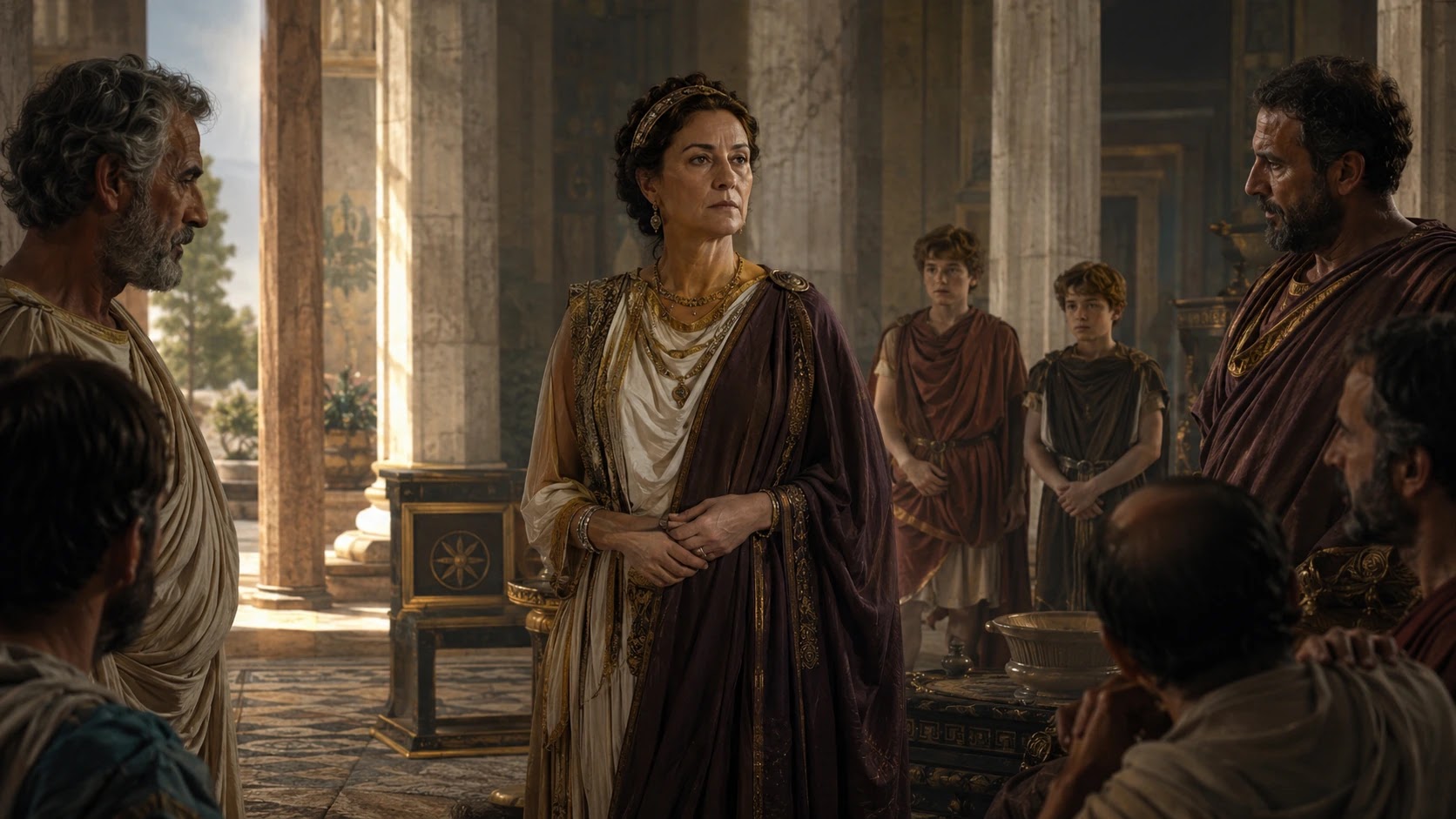
Eurydice, grandmother of Alexander the Great, reveals the political role of Macedonian queens in the crises that prepared Alexander's empire.
Before Alexander the Great, before the conquests that would carry Macedonian armies to the gates of India, before even Philip II transformed a fragile kingdom into the dominant power of the Greek world, there was a woman in the shadow of the palaces: Eurydice I of Macedon.
Her name does not echo with the same force as that of Olympias, Alexander's brilliant and unsettling mother. Nor does it carry the military glory of Philip II. Yet without Eurydice, the royal house of the Argeads might have fallen into one of those political abysses that ancient Macedonia knew so well.
A Princess from Lyncestis
Eurydice was probably born near the end of the fifth century BC, perhaps between 410 and 404 BC, though no exact date can be established with certainty. This uncertainty should not be treated as a simple biographical detail. It reminds us how often the history of ancient women depends on indirect references, late testimony, and polemical contexts.
For Eurydice, dates are inferred mainly from the careers of her husband and her sons. The result is a figure historically solid in her political role, but still hazy in her childhood, training, and early years.
She came from Lyncestis, in Upper Macedonia, a strategic territory west of the Macedonian kingdom. Her father is named Sirras or Sirrhas in ancient traditions. Through her family, Eurydice belonged to an aristocratic network that was valuable to Macedonian kings, who needed strong alliances in these frontier regions.
Lyncestis was not an insignificant periphery. Located in Upper Macedonia, it was one of those spaces where royal authority had to negotiate with powerful local houses, capable of becoming precious allies or dangerous enemies. By marrying a woman from this region, Amyntas III was not simply choosing a wife of suitable rank. He was linking himself to a territory whose control shaped the western security of the kingdom.
Ancient sources and modern interpretations diverge on Sirras's origin. Some testimony associates Eurydice with the Illyrian world, while other analyses connect her more closely to Lyncestis. It is therefore better to speak of a frontier origin, between Lyncestian, Macedonian, and possibly Illyrian networks.
For Amyntas, the immediate issue was probably less theoretical than strategic. An alliance with Lyncestis helped secure the marches of the kingdom, where Macedonian, Illyrian, and Greek influences met. Eurydice arrived at court with political capital already inscribed in her family name.
Her marriage to Amyntas III, around 390 BC, was not merely a family union. It was a political alliance. Amyntas III was himself a king of survival. His reign was marked by threats from several directions, especially from the Illyrians and from the cities of Chalcidice. In that context, matrimonial diplomacy became an instrument as necessary as war. Alliances were not only signed. They were embodied by women brought into the royal house.
Eurydice belonged to that political logic, but she was not reduced to it. Her marriage brought her to the center of a kingdom trying to anchor itself to several networks: Upper Macedonia, Thessaly, Athens, Thrace, and the cities of Chalcidice.
The fact that Amyntas also sought ties with Iphicrates, a leading Athenian general, shows that the Macedonian monarchy used every resource of real or symbolic kinship. Later, Eurydice would know how to mobilize precisely that symbolic kinship with the Athenian general. Her political intelligence was rooted in a world where family alliance and diplomatic alliance often overlapped.
Macedonia at this time was not yet the empire on the march that we imagine from Alexander onward. It was an unstable kingdom, threatened by Illyrians, watched by Greek cities, and crossed by clan rivalries. Kings often died violently. Claimants appeared as soon as a ruler faltered.
We should not imagine this Macedonia as a classical Greek city, with visible civic institutions and structured public debate. Power rested more on the person of the king, his military capacity, his aristocratic companions, and regional balances. This structure made the kingdom quick in action, but vulnerable to sudden deaths. At every royal disappearance, everything could begin again: oaths, betrayals, coalitions, and competing claims.
Mother of Kings, Grandmother of a Conqueror
From her union with Amyntas III came several children. The best known are three sons: Alexander II, Perdiccas III, and Philip II. All three became kings of Macedon. A daughter, Eurynoe, is also mentioned in some traditions.
This royal motherhood was essential. In ancient monarchies, giving birth to heirs was never a merely private fact. It was a dynastic act. Through her sons, Eurydice became the living center of Argead continuity.
The destinies of her three sons gave Eurydice an exceptional position in Macedonian history. Alexander II represented the fragile hope of direct succession after Amyntas. Perdiccas III symbolized a temporary restoration of dynastic authority before military catastrophe against the Illyrians. Philip II transformed the threatened inheritance into conquering power.
Through them, Eurydice passed through three moments: protection, transition, and fulfillment. This continuity gives her motherhood a rare political dimension, because it links the vulnerable Macedonia of Amyntas directly to the victorious Macedonia of Philip.
But that continuity was fragile. At the death of Amyntas III, around 370 or 369 BC, his eldest son Alexander II ascended the throne. He was young. The kingdom was vulnerable. Very quickly, tensions multiplied: claimants, ambitious nobles, foreign interventions, Illyrian and Theban pressures. Macedonia again seemed ready to tear itself apart.
The death of Amyntas did not simply cause a change of reign. It reopened the fundamental question of obedience. In a monarchy like Macedonia, the disappearance of the king immediately released contained ambitions. Nobles could hesitate, neighbors could intervene, exiles could return, and Greek cities could try to exploit the confusion.
Alexander II therefore inherited not only a throne, but also a minefield. The youth of the sovereign increased the dynasty's vulnerability. Eurydice, as widow of the dead king and mother of the legitimate princes, became one of the last fixed points of the system.
Her authority did not rest on an official title of regent, since such a role is not clearly attested for Macedonian women at this date. It rested instead on recognition of her rank, her networks, and her ability to act at the right moment. This form of informal power is what makes her case so valuable to the historian. This is where Eurydice steps out of the shadows.
The Succession Crisis: Eurydice Facing Chaos
After the death of Amyntas III, Eurydice found herself in a dangerous position. Her son Alexander II was assassinated a few years after taking power, probably in a context of rivalries involving Ptolemy of Aloros, an influential figure at the Macedonian court.
Ancient accounts diverge on the details, and some are clearly hostile to Eurydice. Ptolemy of Aloros remains one of the most difficult figures to understand in this period. He appears in the traditions as a courtier, a military actor, and a possible rival to the direct line of Amyntas. His exact position in relation to Eurydice and her sons is blurred by late and sometimes contradictory narratives. That obscurity must be preserved, because it prevents us from turning an ancient hypothesis into a modern certainty.
The Roman historian Justin, writing centuries after the events as he summarized the lost work of Pompeius Trogus, presents Eurydice in a very dark light: scheming, adulterous, connected to Ptolemy, even complicit in dynastic crimes.
Modern scholars treat this testimony with caution. Anne Jacquemin's article reminds us that Justin transmits a genuine "black legend," going so far as to attribute to Eurydice crimes against her husband and her elder sons. Justin's account may preserve older traditions, but it transmits them in a condensed, moralized, and sometimes novelistic form. The accusations against Eurydice belong to a familiar register of ancient historiography: the influential woman easily becomes adulteress, poisoner, manipulator, or unnatural mother.
This does not mean rejecting Justin entirely. It means understanding the mental framework in which he writes. When a queen acts politically, male ancient narrative often translates that action into sexual or familial disorder. That mechanism is precisely what must be analyzed.
Eurydice is not only a person to be narrated. She is also a case study in how ancient sources construct the reputation of a woman in power. We must therefore proceed carefully. We cannot prove that Eurydice was innocent of all political maneuvering. In royal Macedonia, no one survived at the summit without strategy.
But the most sensational accusations, a criminal affair, a plot against her own sons, a monstrous alliance with Ptolemy, strongly resemble a hostile tradition forged in a world where a politically active woman quickly became suspect.
Historical caution does not weaken the story. It gives it more force. Saying "we do not know" allows us to distinguish serious reconstruction from historical fiction. In Eurydice's case, this nuance is essential, because her image oscillates between two poles: the protective mother of Aeschines and the schemer of Justin.
The interest of her portrait arises precisely from that documentary tension. What is better attested, however, is her decisive action to protect her surviving sons.
Eurydice's Appeal to Iphicrates
The most famous testimony comes from the Athenian orator Aeschines, in his speech On the Embassy. He reports that Eurydice, when her sons Perdiccas and Philip were threatened by a claimant named Pausanias, appealed to the Athenian general Iphicrates.
Iphicrates was not an ally chosen at random. He was one of the great Athenian military leaders of the fourth century BC, famous for his experience in Aegean warfare and for tactical innovations. The bond that Amyntas had supposedly established with him through a form of symbolic adoption shows how far the personal diplomacy of Macedonian kings could go. Eurydice understood that this bond could be reactivated when ordinary institutions were not enough.
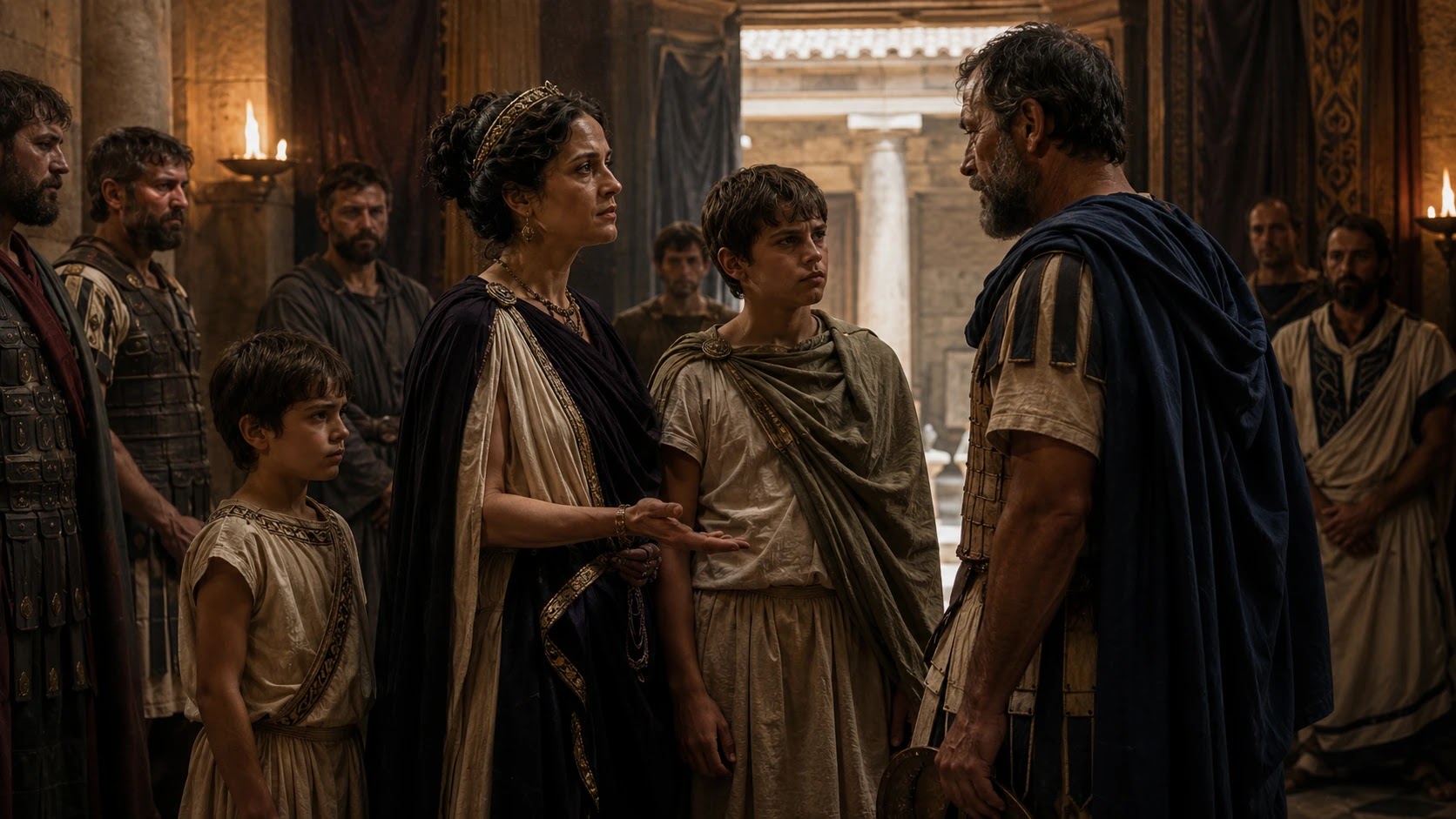
She transformed an old relationship into a present obligation. The gesture is remarkable because it cleverly blended family emotion and political calculation. By placing the children before Iphicrates, she did not merely beg. She made the threatened dynasty visible. She forced the general to see not an abstract quarrel of succession, but two princely bodies entrusted to his loyalty.
According to Aeschines, Iphicrates drove out Pausanias and thus preserved the dynasty. This makes the episode one of the rare moments in which the political action of a Macedonian queen is explicitly recognized by an ancient source.
The scene is striking. According to Aeschines, in a moment probably dramatized for the needs of political eloquence, Eurydice placed Perdiccas in Iphicrates' arms and Philip on his knees. She reminded him that her late husband Amyntas had regarded Iphicrates as an adopted son and that, through this relationship, the Athenian general owed protection to the threatened children.
Iphicrates then intervened against Pausanias and helped preserve the dynasty. The staging has almost the force of a political painting. The children are not described as simple minors in danger, but as the bearers of a dynastic order that must be saved.
Eurydice used the language of blood, adoption, and friendship between powers. In a Macedonia where power rested on personal loyalties, this argument was extremely effective.
Of course, Aeschines had his own political aims when he told this story. He was speaking in Athens, in the context of rivalries tied to relations with Philip II. His account also served to remind his audience that Macedonia owed something to Athens.
This intention does not cancel the value of the testimony, but it requires us to read it as a piece of political rhetoric. Aeschines probably dramatized Philip's youth, since other evidence suggests that he may not have been as childlike as the scene implies. Anne Jacquemin underlines this difficulty: the future Philip II was probably about thirteen at the time of the episode, which makes the image of a toddler placed on Iphicrates' knees clearly rhetorical.
Yet the basic structure of the episode remains historically valuable: a threatened queen mother called on a foreign general to defend the succession of her sons. Even embellished, the scene preserves the trace of an exceptional female initiative. This is not a passive silhouette. This is a woman who helped save the future of her sons. Among those sons was Philip II, future father of Alexander the Great.
Philip II: Heir to Eurydice as Much as to Amyntas
When Philip II's rise is told, emphasis often falls on his stay as a hostage at Thebes, his military apprenticeship, his reform of the Macedonian phalanx, and his ruthless diplomacy. All of this is true. But before Thebes, Philip knew the Macedonian court, a world where the life of a prince could be overturned in a few days.
Philip's stay at Thebes has often been presented as the political and military school of the future conqueror of Greece. There he observed a victorious city, the power of the Theban army, the prestige of Epaminondas, and the effectiveness of disciplined military organization.
But before that, he had also seen kingship threatened from within, alliances reverse, and claimants take advantage of mourning. This family experience may have fed his early understanding of political danger.
Eurydice's lesson was therefore not merely sentimental. It was strategic: survival required knowing how to call on the useful ally, exploit an old debt, choose the right moment, and transform weakness into an argument.
Philip would later apply that grammar on an incomparable scale. His diplomacy, marriages, oaths, and reversals may carry the echo of a maternal world in which politics was already a matter of blood, memory, and urgency.
It would be excessive to claim that Eurydice directly trained Philip as a master teaches a student. The sources do not allow such certainty. But it is reasonable to stress that she offered a model of action in a time of crisis. Philip did not inherit only a name. He inherited a family memory of survival.
Philip II later became a master of three arts: alliance, audacity, and speed of decision. His seizure of power in 359 BC must be placed within a tense dynastic continuity. After the death of Perdiccas III against the Illyrians, the legitimate heir could have been the young Amyntas IV, son of Perdiccas.
Yet Philip imposed himself, first in a form of regency, then as effective king. This passage shows that Macedonian legitimacy was not reducible to primogeniture. It also depended on the ability to protect the kingdom, command the army, and appear as the only man capable of containing collapse.
The fact that Philip was the son of Amyntas III and Eurydice strengthened his authority against other claimants. The maternal line did not replace military action, but it gave that action dynastic depth.
In less than a generation, Philip transformed Macedonia into a major power, imposed his authority on the Greek world after Chaeronea in 338 BC, and prepared the great expedition against the Persian Empire that his son Alexander would carry to its height.
Behind this trajectory, Eurydice appears as a foundational figure. She conquered no territories. She commanded no known army. But she protected the line that made those conquests possible.
A Literate Woman in Ancient Macedonia
Another detail, less spectacular but fascinating, comes from a text transmitted in the corpus of Plutarch, On the Education of Children. The passage reports a dedication by Eurydice to the Muses, connected to her learning to read or write.
The attribution of this treatise to Plutarch has been debated, and scholars often speak today of Pseudo-Plutarch, but the testimony remains important for understanding Eurydice's cultural memory.
The passage is brief, but it opens a rare window onto the culture of royal Macedonian women. It suggests that Eurydice associated her education with a form of religious gratitude. Learning to read is not presented as a domestic detail, but as a good worthy of being placed under the patronage of the Muses. For a queen, culture becomes a resource of prestige.
In the classical Greek imagination, Macedonia was sometimes seen from the south as a rougher, more monarchic, less polished space than the cities of the Aegean world. Yet the Macedonian court was far from isolated from Greek cultural practices. Kings welcomed artists, diplomats, poets, physicians, and soldiers from varied horizons.
The education of elites did not always take the same forms as in Athens, but it was not absent. For royal women, this education had a particular function. It could help manage property, cults, alliances, and the memory of the dynastic house. Through her offering to the Muses, Eurydice presented herself as a woman who had acquired a skill and understood its value.
The detail becomes even more interesting if the learning took place late in life, as some commentators have imagined. It would suggest a queen capable of forming herself over the course of her life, not merely a princess educated from childhood in cultural comfort.
This is a valuable narrative angle. Eurydice is not frozen in her status. She also constructs herself through learning. Her offering to the Muses is therefore not a simple pious gesture. It says something about her identity: Eurydice wanted to be seen as an educated woman, conscious of her rank, able to present herself publicly as more than the wife of a king.
The Eukleia Inscriptions: "Eurydice, Daughter of Sirras"
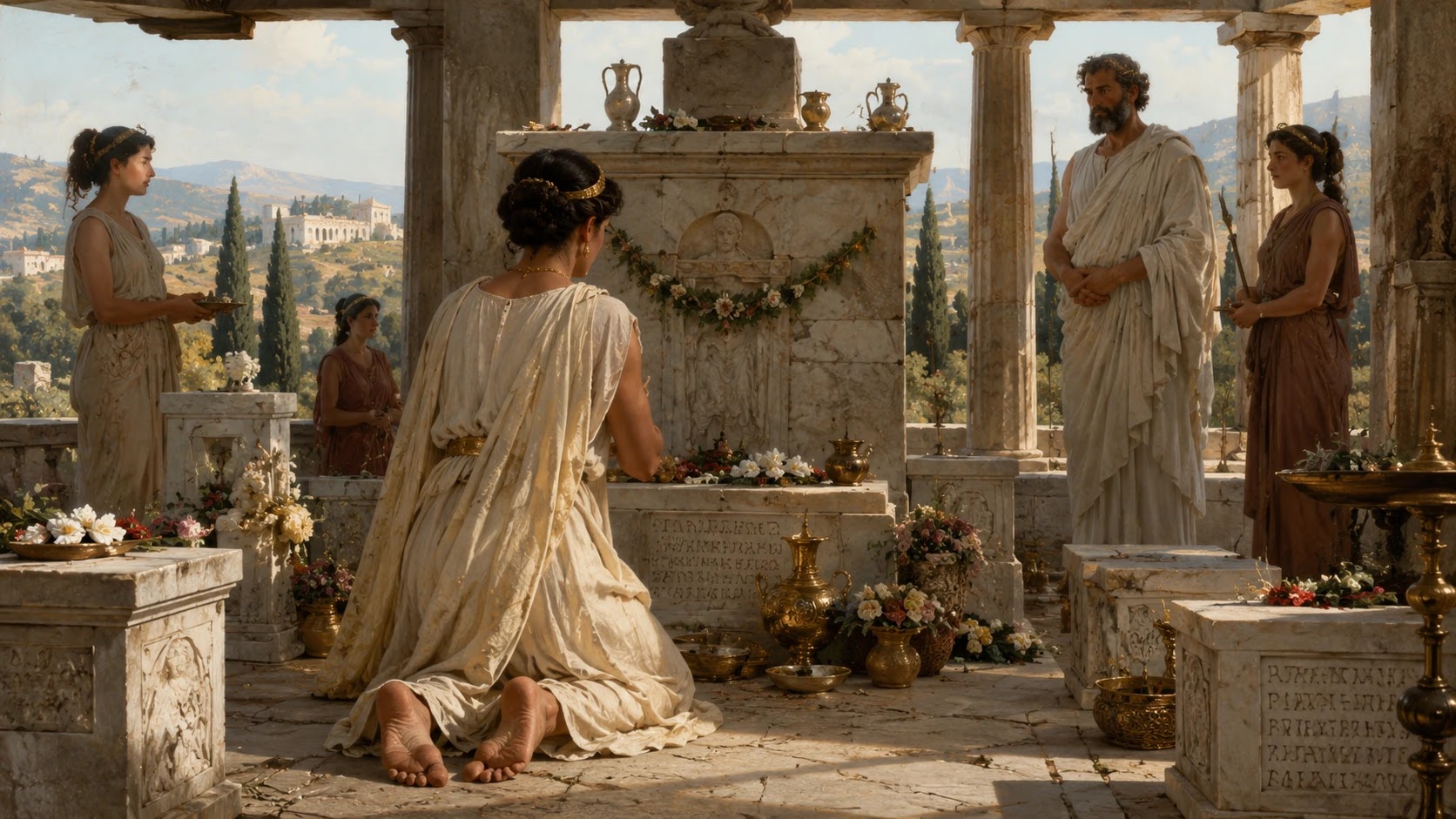
Archaeology has given Eurydice back a brief but powerful voice. At Vergina, ancient Aigai, inscriptions connected to the sanctuary of Eukleia have been found. They bear a simple formula: "Eurydice, daughter of Sirras."
This detail is remarkable. She does not present herself there as "wife of Amyntas" or "mother of Philip." She claims her own name and her own filiation. These inscriptions are precious because they do not pass through the filter of a moralist or an orator. They do not narrate Eurydice. They name her.
Their discovery in the area of Aigai, near the sanctuary of Eukleia, places the queen in a civic and religious space, not only in the funerary world.
Archaeology thus reveals a royal presence at the heart of the old Macedonian capital. The formula "daughter of Sirras" is especially striking because it avoids the expected titles of wife or mother. Eurydice chose, or caused to be engraved, an identity attached to her line of origin. This gesture can be read as an assertion of personal and family prestige.
The official site of Aigai also mentions a statue of Eurydice as a votive offering in the sanctuary of Eukleia, dated to the third quarter of the fourth century BC. It also mentions the "false window" of the tomb traditionally called the "Tomb of Eurydice," dated to 344 or 343 BC, without this identification being definitively secure.
Prudence is necessary here. The exact identification of certain Macedonian funerary monuments remains debated. Elizabeth Carney, in her study of Eurydice, doubts for example that the so-called Tomb of Eurydice must necessarily be identified as the queen's tomb, while still seeing it as probably the burial of a royal woman.
Eukleia is associated with glory, good reputation, and sometimes Artemis. The very name Eukleia points to honorable renown, a reputation that goes beyond simple military victory. For a queen engaged in the survival of a dynasty, the choice of such a divinity was probably not neutral.
The offering can be understood as an act of piety, but also as a symbolic act of speech. Eurydice entrusted her name to stone, where the stories told by men might distort it.
Eurydice's Memory in the Philippeion at Olympia
After Philip II's victory at Chaeronea in 338 BC, an exceptional monument was raised at Olympia: the Philippeion. According to Pausanias, it contained a group of statues representing Philip, Alexander, Amyntas, Olympias, and a Eurydice.
The identification of this Eurydice with the mother of Philip II is traditional and defended by Elizabeth Carney, but it has been debated. Some scholars have proposed seeing Cleopatra-Eurydice, Philip's last wife, instead.
The statues are lost, and Pausanias describes them as works in gold and ivory. Some modern debates concern the exact materiality of the group. Nevertheless, the Philippeion remains one of the most eloquent monuments of Macedonian dynastic propaganda.
Raised in the Panhellenic sanctuary of Olympia, it did not speak only to Macedonians, but to the entire Greek world. After Chaeronea, Philip had to present his domination not as simple military coercion, but as a legitimate, heroic power inscribed in the Greek order.
The choice of family statues participated in that staging. If we follow the traditional identification, Amyntas and Eurydice represented dynastic rootedness, while Philip, Olympias, and Alexander embodied present and future fulfillment.
The fact that a Eurydice appeared in this group is considerable. A woman whose literary sources are rare was thus integrated, under this reading, into a monumental program of first importance. Even though the statues have disappeared, her presence in the composition reported by Pausanias confirms that an essential female name belonged to the official story of the royal house.
This choice was deeply political. Philip II did not simply glorify his own reign. He staged his lineage. By placing a Eurydice among the honored figures, the Philippeion associated Macedonian power with female family memory, whether she was Philip's mother according to the traditional identification or Cleopatra-Eurydice according to the alternative hypothesis.
In the first reading, Alexander's grandmother entered the monumental memory of the dynasty. She was not erased. She was displayed.
Eurydice and Olympias: Two Queens, Two Memories
The comparison with Olympias, mother of Alexander the Great, is unavoidable. Olympias is more famous, more theatrical, and better known from ancient narratives. Her relationship with Alexander, her conflict with Philip, and her role after the conqueror's death have nourished the historical imagination.
Olympias fascinates because the sources show her in an age of thunder: the assassination of Philip, Alexander's conquest, and then the wars of the Diadochi.
Eurydice belongs to an earlier phase, less spectacular but perhaps more foundational. Where Olympias acted in the immense shadow of an empire already launched, Eurydice acted in a kingdom still threatened with disappearance. The first embodied the struggle for Alexander's inheritance. The second embodied the struggle to make that inheritance possible.
Eurydice shows that a royal Macedonian woman could intervene in succession, mobilize allies, appear in religious space, and be honored in dynastic monuments. In this sense, she foreshadows the great women of Macedonia and the Hellenistic world: Olympias, Cynane, Adea-Eurydice, Thessalonike, and Cleopatra of Macedon.
Eurydice's importance also lies in the fact that she anticipates a broader evolution of female power in the Macedonian monarchy. From the fourth century BC onward, women of the dynasty were no longer only instruments of matrimonial alliance. They sometimes became visible actors in succession.
This evolution does not mean political equality in the modern sense. It means rather that the Macedonian monarchy, because it rested on the royal house, gave the women of that house a role that classical Greek cities rarely granted to their female citizens.
When the king died, when the heir was young, when the line was contested, the queen mother could become a figure of continuity. Eurydice is one of the earliest clear examples of this function. In that sense, she opened a path that later generations would follow with more violence, more ambition, and sometimes more visibility.
Historical debate
Eurydice's memory is divided between hostile literary traditions and more restrained evidence. Justin presents her through a dark moralizing tradition, while Aeschines preserves a scene in which she acts to protect her sons and the dynasty. The inscriptions from Aigai add a different kind of evidence: they do not tell a story about Eurydice, but they preserve her name and public presence outside later accusations.
The central caution is therefore methodological. Eurydice should not be reduced either to Justin's hostile portrait or to a modern heroic reconstruction. The safest reading is that she was a politically active royal woman whose importance is visible precisely where the sources become tense: succession, legitimacy, family memory, and public religious display.
A Fragile Yet Essential Memory
Why does Eurydice remain so little known? First, because the sources are rare. Then, because the history of Alexander tends to draw all the light toward itself. His father Philip himself was long reduced to the role of "preparer" of the conquest. So his grandmother, a woman from the early fourth century BC, had little chance of surviving in popular memory.
There is also a narrative reason: Eurydice left behind no great battle, famous saying, or spectacular episode comparable to the Gordian Knot. Her power is measured in preservation, not in conquest. Yet popular history often prefers those who take cities to those who prevent a dynasty from collapsing. It is precisely this injustice of memory that can be corrected.
For history is not built only with the most dazzling battles. It is also built in palace corridors, in marriage alliances, in calculated supplications, in diplomatic gestures, in names engraved on stone. Eurydice belongs to that history: less spectacular, but decisive.
In the Macedonian case, the palace is a political space every bit as decisive as the battlefield. Honors are distributed there, marriages are arranged there, ambassadors are received there, young princes are observed there, as are the men capable of betraying them. A queen like Eurydice moves through this dense space, where every word can become a promise and every silence a threat.
Her power is not institutional in the strict sense. It is relational. She knows who has been tied to her family, who can be reminded of their obligations, who can become a protector or a rival. This form of power leaves few traces in military chronicles, yet it shapes events.
The inscriptions of Aigai, the memory of Aeschines, and the possible presence in the Philippeion, if one follows the traditional identification, form three flashes of the same phenomenon. They reveal a woman who acts, names herself, and is remembered. That is rare enough to become the analytical heart of her portrait.
Without her, Philip II might have disappeared amid the violence of succession. Without Philip II, Alexander would not have inherited the army, the power, and the eastern project that made his glory. Eurydice was therefore not merely "the grandmother of Alexander the Great." She was one of the guardians of the dynasty that made Alexander possible.
What the sources say
Primary sources: Aeschines preserves the episode in which Eurydice appeals to Iphicrates to protect Perdiccas and Philip; Justin transmits a much more hostile tradition; Pseudo-Plutarch links Eurydice to learning and a dedication to the Muses; Pausanias describes the dynastic statue group of the Philippeion at Olympia.
Modern references: Elizabeth Donnelly Carney's work is central for Eurydice and Macedonian royal women. Anne Jacquemin, Chrysoula Saatsoglou-Paliadeli, and Olga Palagia are used here for the inscriptions, the sanctuary context, and the debated identification of Eurydice in the Philippeion.
Historical caution: the article treats Justin's accusations carefully because they belong to a later and moralizing tradition. It also keeps the identification of some monuments and figures cautious when the evidence is debated.
Further reading on Echoes of Antiquity
- Alexander the Great: The Untold Story of His Greatest Rival, Memnon of Rhodes
- Parmenion: The Forgotten General Behind Alexander the Great's Conquests
- King's Peace (387/386 BC): Artaxerxes II and the Peace of Antalcidas
- The Battle of Marathon: The Clash That Shaped Western Civilization
Sources and Historical Landmarks
- Aeschines, On the Embassy, 343 BC, ed. ToposText / Loeb Classical Library, 1919.
- Pseudo-Plutarch, On the Education of Children, first-second century AD, ed. Loeb Classical Library, 1927.
- Justin, Epitome of the Philippic History of Pompeius Trogus, second-third century AD, trans. John Selby Watson, G. Bell, 1876.
- Pausanias, Description of Greece, second century AD, ed. ToposText / Loeb Classical Library.
- Elizabeth Donnelly Carney, Eurydice and the Birth of Macedonian Power, Oxford University Press, 2019.
- Elizabeth Donnelly Carney, Women and Monarchy in Macedonia, University of Oklahoma Press, 2000.
- Elizabeth Donnelly Carney, "Argead Women and Religion", 2022, Karanos, Universitat Autonoma de Barcelona.
- Anne Jacquemin, "The Dedication to the Muses by Eurydice, Daughter of Sirrhas", 2019, Ktema, Persee.
- Chrysoula Saatsoglou-Paliadeli, "Eukleia and Eurydice, Daughter of Sirrhas. Revisiting Old and Newer Marble Finds from Vergina-Aegae", 2017, Glyptike: Timitikos Tomos.
- Olga Palagia, "Philip's Eurydice in the Philippeum at Olympia", 2010, in Elizabeth D. Carney and Daniel Ogden, Philip II and Alexander the Great, Oxford University Press.
- Aigai, "Gallery - Archaeology in the Heart of Macedonia", official Aigai website.


