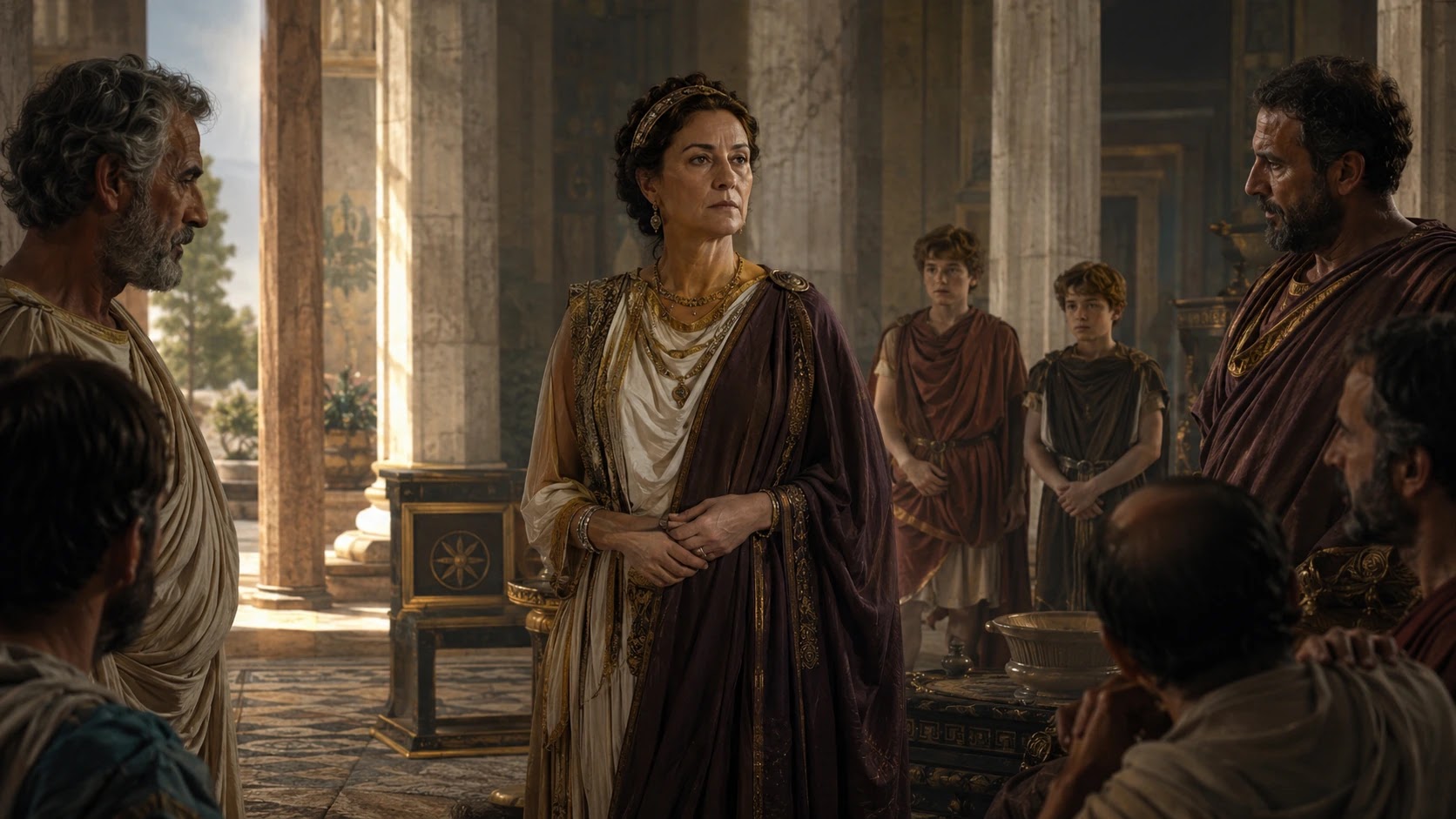
On a road in Greek Sicily, two young women stop a passerby. They wear no crown, carry no weapons, command no army, and come from no palace. Yet their quarrel will travel across the centuries. This is not a story of power, conquest, or revenge. It is a story of beauty, desire, and that invisible force the Greeks placed under the gaze of Aphrodite.
A Beauty Quarrel in Greek Sicily
Most of the stories antiquity has left us speak of kings, conquerors, battles, and gods. We meet Achilles before the walls of Troy, Alexander at the gates of Asia, and Roman legions marching beneath the burning sun of the East. Yet some ancient texts preserve far humbler stories. They do not stage armed heroes or trembling empires. They simply tell of men and women facing one of the oldest powers in the world: beauty.
Among these nearly forgotten anecdotes stands the story of Aphrodite Kallipygos, “Aphrodite of the beautiful buttocks.” At first glance, the subject invites a smile. The story seems light, almost frivolous. Two young women argue over their physical appearance, a young man is asked to judge, love bursts in, then a second love follows, and at last a temple is dedicated to a goddess.
And yet, behind that apparent simplicity, something deeply Greek is at work. In much of ancient culture, the body is not merely a shell. It can become a sign of harmony, a promise of desire, an object of rivalry, a manifestation of divine power. Beauty is never entirely innocent. It acts. It disturbs. It draws the eye and can transform a life.
The story is known to us chiefly through Athenaeus of Naucratis, a Greek author of the second and third centuries AD. In his Deipnosophists, a vast compilation of learning staged as a banquet, he preserved countless anecdotes that time would likely have erased. Thanks to him, we can still hear the echo of this curious tradition from Syracuse, in Greek Sicily.
We should say this from the start: we are not dealing with a documented historical event in the way we would approach a battle, a dated inscription, or a diplomatic treaty. Athenaeus reports an older tradition, already wrapped in storytelling, local memory, and perhaps legend. But that is precisely what gives it power. Some stories do not need a decree carved in bronze in order to survive the centuries. They need only an image.
Here, everything begins far from royal palaces and battlefields, with two young women of rural and modest origin.

Two Modest Young Women Before the Male Gaze
A Story from Syracuse
In the Greek memory of Syracuse, that powerful Sicilian city founded by colonists from Corinth, a singular story circulated. Syracuse was one of the great Greek cities of the West. Its harbors opened Sicily to the Mediterranean. Its tyrants at times unsettled Carthage, Rome, and the other Greek cities. Its sanctuaries, markets, theaters, and streets must have seen generations of merchants, soldiers, poets, farmers, and women whose names have vanished.
Let us imagine the scene for a moment, not as a documentary certainty, but as a doorway into that world. Sicilian light falls across the roads. In the distance, the white city rises above the sea. Farmers come to sell their produce, travelers cross paths with citizens, young men pass along the roads. In this world where city and countryside constantly brush against one another, two sisters appear.
Athenaeus does not give us their names. He says they are the daughters of a farmer. They do not belong to the great families whose genealogies fill historical books. They come from a quieter, simpler world: fields, roads, and modest homes. Nothing seemed destined to carry them into history.
And yet, an intimate quarrel was enough to make them famous for more than two thousand years.
The Strangest Contest in Antiquity
The two young women shared one conviction: they were beautiful. But which of them was more beautiful?
The disagreement became so lively that they decided to submit the question to an outside judge. The choice may seem strange to us, but it reveals something of the Greek imagination. The Greek world loved the agon, the contest, the comparison, the verdict: athletic games, poetic competitions, musical contests, trials of strength, skill, intelligence, and beauty. In this anecdote, that logic of ranking slips toward the female body with a frankness that can still surprise us.
The two sisters, then, notice a young man passing along the road. They call to him and ask him to settle their dispute. The boy’s embarrassment must have been immense, but curiosity, or perhaps already the invisible hand of Aphrodite, prevailed.
The young women then revealed the part of their anatomy at the center of the debate: their buttocks. The young man looked, compared, reflected, and finally delivered his verdict. The elder sister won.
What might have remained a simple aesthetic judgment would become a small love tragedy, not bloody, but feverish, as though Eros had hidden himself in the dust of the road.
The Judgment of the First Brother
As soon as the comparison was over, something changed in the young judge. Greek writers often use a recurring image for love: the wound. Eros acts like an invisible archer. He looses his arrows without warning and turns certainty into torment.
The young man returned home unable to forget the woman he had chosen. Her figure pursued him. The memory of the scene returned again and again. Each day deepened his obsession. Soon, he began to waste away. Athenaeus tells us that he fell in love, then fell ill, to the point that he took to his bed.
The Greeks would not necessarily have spoken of mere attraction. In this anecdote, as in many other ancient stories, love is not only an emotion: it reaches the body. It burns, weakens, steals sleep, and turns desire into fever. The gaze has passed through the skin and gone straight to the heart.
Beauty had ceased to be a spectacle. It had become a destiny.

When Eros Makes You Sick
Love as an Ancient Fever
In ancient tragedies, poems, and novels, love often has an almost medical power. It can make someone pale, restless, silent, and melancholic. It can steal appetite, disturb breathing, and consume the mind. The Greeks knew very well that passions do not remain inside ideas. They descend into the blood.
Watching this young Syracusan sink into sadness, his family eventually understood that a strange illness was eating away at him. The cause? A young woman glimpsed for only a few moments. One encounter had been enough, one look had changed a life.
This way of telling love can sometimes feel excessive. Yet it strikes true. Who has never felt that a face, a gesture, or a presence could fill the whole interior world? The Greeks gave that experience a mythological shape. Behind it they placed Eros, Aphrodite, and the gods of disturbance and attraction.
The young man thought he had judged beauty. In truth, he had just been judged by it.
The Younger Brother and the Second Sister
The story could end there. But this is precisely where it becomes truly remarkable.
The young man’s younger brother hears of this mysterious beauty. Intrigued, perhaps worried for his brother, he decides in turn to go and see the two young women. He meets the sisters. And while his brother has fallen for the elder, he immediately notices the younger.
The story repeats itself. He too falls in love. He too refuses to think of any other woman. He too finds himself captive to a fascination he cannot master.
The symmetry of the tale is almost perfect: two sisters, two brothers, two judgments, two passions. As though Eros had decided to distribute his arrows with geometric precision.
There is something both delightful and deeply antique here. Love does not arrive alone. It doubles itself. It answers its own echo. One flame calls forth another, and the road to Syracuse suddenly becomes the stage for a small divine choreography.
From Desire to Marriage
Fortunately, unlike so many other Greek stories, this one does not end in blood.
Athenaeus tells us that the father of the two young men first tried to turn them away from their passion. He likely wanted more suitable marriages. But his sons remained unshakable. They wanted no other women. Their desire had taken root.
So the father finally yielded. He persuaded the father of the two young women to give them in marriage. The two brothers therefore married the two sisters.
What began as a quarrel over beauty became an astonishing social ascent. The farmer’s daughters entered a wealthier family. They left the anonymity of the roads and became the heroines of a story still told centuries later.
But their success does not end there. Soon, their story crosses into another realm: religion.

Aphrodite Kallipygos: When the Body Becomes a Cult
What Does “Kallipygos” Mean?
The word may surprise us, but it means exactly what it says. Aphrodite Kallipygos means Aphrodite “of the beautiful buttocks.” The term comes from ancient Greek kallos, beauty, and pygê, buttocks. In this epithet, there is neither detour nor prudery. The Greeks name the body with a frankness that still startles us.
Yet the expression should not be reduced to a crude joke. In the Greek world, bodily beauty belongs to a larger order. It can signal harmony, divine favor, and erotic power. The body is not only flesh. It is language. It says something about being, youth, desire, and sometimes even closeness to the gods.
In this story, Aphrodite does not appear as a distant goddess frozen inside a marble sanctuary. She erupts into everyday life, at the turn of a quarrel between two modest sisters. She transforms an almost comic scene into a sacred event. That is the whole flavor of the tale: a private anecdote, born of laughter and disturbance, eventually enters the religious memory of a city.
From Anecdote to Temple
Once married and enriched, the two young women do not simply vanish into the comfort of their new status. According to the tradition reported by Athenaeus, they built a sanctuary dedicated to Aphrodite Kallipygos. The gesture is essential. It gives their story a new meaning.
We should remain cautious: to my knowledge, we have no direct archaeological evidence that would allow us to reconstruct with certainty the temple as Athenaeus describes it. But the ancient story asserts that a Syracusan cult of Aphrodite Kallipygos existed, and Clement of Alexandria also mentions this Aphrodite honored at Syracuse, this time from a critical Christian perspective.
This sanctuary, if it did exist in the form attributed to it by tradition, must have celebrated a very particular Aphrodite: not primarily the goddess of peaceful marriage, but the goddess of sudden attraction, physical charm, and the gaze that disarms. The cult reminds us that, for the Greeks, desire is never entirely separated from the sacred.
One could smile at such a foundation. Yet it is deeply revealing. The Greeks knew that the gods did not dwell only on the misty heights of Olympus. They were present in banquets, harbors, bedrooms, marketplaces, gardens, and bodies offered to the light. All of life could become the stage of a divine manifestation.
Here, Aphrodite does not descend in a flash of lightning. She passes through a gaze.
A Goddess Between Beauty, Desire, and the Greek Smile
There is something very Greek in this story: beauty is at once dangerous, comic, and sacred. It makes people laugh, makes them sick, enriches them, and elevates them. It creates disorder before producing a new kind of order.
The two brothers could have fallen into despair. The two sisters could have remained anonymous. But Eros, in this tale, does not destroy. He unites. He gives a happy resolution to what might have become suffering. Lovesickness finds its remedy in marriage, and marriage finds its continuation in cult.
It is almost a small divine comedy. Aphrodite, unseen, seems to smile behind the curtain.
Through her, the Greeks remind us of something simple and troubling: the body is never neutral. It draws the eye, triggers stories, and sometimes founds memories. A part of the body that modern modesty often pushes into the realm of ridicule becomes here the starting point for a religious story.
Antiquity has that rare talent: it knows how to give depth to light things.

From Greece to La Fontaine: A Story Across the Centuries
Athenaeus, the Banquet of Anecdotes
If this story reached us, it is thanks to Athenaeus of Naucratis. His work, the Deipnosophists, is a strange and precious monument. In it, learned diners discuss food, wine, pleasure, poetry, famous women, ancient customs, and a thousand details that grand historical narratives often neglect.
Athenaeus is not a historian in the strict sense. He compiles, quotes, gathers. He saves fragments. At times, he resembles those collectors who pick up scattered tesserae from the ruins of a mosaic. Thanks to him, we know not only battles and constitutions. We also glimpse table talk, learned jokes, and the curiosities of everyday life.
The anecdote of Aphrodite Kallipygos belongs to this side memory of antiquity. It is not essential for understanding the politics of Syracuse. It does not alter the course of the Punic Wars. It topples no empire. And yet, it illuminates a world.
It shows us how the Greeks told stories about desire, how they associated beauty with the divine, and how an almost bawdy tale could find a place within a sophisticated culture.
Clement of Alexandria and the Christian Gaze
This particular Aphrodite also appears in early Christian memory. Clement of Alexandria, in his Protrepticus, refers to pagan cults with a critical eye. For him, those cults reveal the error of the Greeks, too attached to images, bodies, passions, and earthly seductions.
His testimony is precious, even when it condemns. It shows that the cult of Aphrodite Kallipygos was well known enough to be cited in religious polemic. Where the Greeks may have seen the smile of a goddess, Clement saw proof of carnal idolatry.
This change in perspective is fascinating. Between pagan antiquity and early Christianity, the body changes status. It remains important, of course, but it becomes more suspect. What the Greek universe could celebrate with an almost sunlit frankness becomes, in part of Christian thought, a cause for scandal or moral warning.
The story of the two Syracusan sisters therefore crosses a cultural threshold. It no longer tells only of love and beauty. It becomes a witness to the passage from one world into another.
La Fontaine and the Venus Kallipygos
Much later, the story reappears in French literature. Jean de La Fontaine, too often reduced to the fables learned in school, also wrote tales that were far freer, sometimes frankly licentious. The story was transmitted in his works under the title La Vénus Callipyge, or A Tale Drawn from Athenaeus.
La Fontaine found in this ancient tale ideal material: desire, wit, a touch of irony, lively sensuality, and a conclusion that allows the smile to triumph. With him, the anecdote leaves Athenaeus’s learned banquets and enters the spirit of the Grand Siècle, not through the grand doorway of classical tragedy, but through a more discreet, more playful door, almost half-open onto a cabinet of curiosities.
It is fascinating to watch this small story circulate across the centuries. Born in Greek Sicily, preserved by an author of the imperial period, debated by Christians, and revived by a French fabulist, it continues to live because it possesses immediate narrative force.
Two sisters.
Two brothers.
One choice.
A sickness of love.
A temple.
That is all memory needs in order to cling.
Why This Anecdote Still Fascinates Us
A Funny Story, But Not Only That
It would be easy to see the story of Aphrodite Kallipygos as nothing more than an amusing curiosity. That would mean missing its richness. As so often in ancient anecdotes, the lightness on the surface hides a deeper observation.
The story first speaks of the gaze. The two sisters ask to be seen, compared, and judged. They take the initiative in a contest that might seem humiliating, yet becomes for them an instrument of destiny. In a society where rural women of modest birth had few ways to rise, their beauty becomes a form of social power.
That power is not without ambiguity. It depends on the male gaze, on men’s desire, and on family decisions. But it is not nothing. The two young women are not merely passive objects of contemplation. They provoke the event. They enter the story through their own boldness.
Perhaps that is what makes the anecdote so alive. It is not only a story of bodies being looked at. It is also a story of bodies that know they can be looked at.
Greek Beauty Is Never Innocent
In the Greek imagination, beauty is rarely calm. It inspires admiration, but also rivalry, jealousy, passion, and sometimes war. Helen of Sparta is the most famous example: a face, or at least the image of a face, is enough to set the stories around Troy ablaze.
The story of Aphrodite Kallipygos is far more modest. It destroys no city. It sends no thousand ships across the Aegean Sea. But it rests on the same principle: beauty acts. It is not decorative. It possesses an almost magical effectiveness.
What moves me in these stories is the way they take seriously the invisible forces that govern human beings. The Greeks did not mock love because it was irrational. They knew, precisely, that its power came from there. Eros does not explain. He strikes. Only afterward do human beings look for reasons.
The anecdote of the two sisters shows this with delicious clarity. A young man thinks he is simply giving a verdict. In truth, he is crossing a threshold. He is entering the territory of Aphrodite.
A Small Story for Understanding a Great Civilization
Great civilizations are not understood only through their institutions, wars, and monuments. They are also understood through their small stories: the ones told after dinner, between two cups of wine, when scholars become storytellers and the gods draw closer to human beings.
Aphrodite Kallipygos belongs to that precious category. It does not have the tragic grandeur of Antigone or the epic splendor of the Iliad. It has something else: immediate humanity. It makes us smile, then makes us think. It reminds us that the Greeks lived in a world where the body, desire, laughter, and the sacred could still occupy the same room.
Of course, caution is necessary. We do not know exactly how much in this story is historical. Athenaeus reports an already ancient tradition. The temple, the sisters, the brothers, and the scene itself may belong as much to local legend as to verifiable history. But that uncertainty does not weaken the text’s interest. On the contrary, it gives it that particular flavor of ancient stories, suspended between memory, folklore, and erudition.
In this story, two young women of modest origin ask that their beauty be judged. Two young men become sick with love. A sanctuary may have been born from this encounter, at least according to ancient tradition. All of this could seem trivial. But in Aphrodite’s mirror, even the most bodily detail can become a doorway toward the invisible.
And perhaps this is where the Greek genius lies: in having understood that a body can be an enigma, desire a religion, and a smile a kind of destiny.
Key Takeaways
- Aphrodite Kallipygos means “Aphrodite of the beautiful buttocks,” an epithet linked to bodily beauty and desire.
- The main story comes from Athenaeus of Naucratis, a Greek author of the second and third centuries AD.
- Two daughters of a farmer from Syracuse were said to have been loved by two brothers after an astonishing beauty judgment.
- The story should be read as an ancient tradition, perhaps mixed with local memory and legend, not as a fully verifiable historical fact.
- La Fontaine later revived this ancient anecdote in La Vénus Callipyge, proof of its long literary afterlife.
Sources
- Athenaeus of Naucratis, The Deipnosophists, Book XII, translated by C. D. Yonge, Attalus.
- Athenaeus of Naucratis, The Deipnosophists, ToposText.
- Clement of Alexandria, Exhortation to the Greeks, translated by G. W. Butterworth, ToposText.
- Clement of Alexandria, Exhortation to the Greeks, THEOI Classical Texts.
- Jean de La Fontaine, The Tales and Novels of J. de La Fontaine, Project Gutenberg.
- Project Gutenberg, Tales and Novels of J. de La Fontaine — Complete, ebook record.