Introduction
In the earliest age of the world, long before stone was assembled into towering pyramids, a single form rose from the primordial waters: a sacred stone, unique and radiant beneath the light of the sun god. This was the benben, the mythical block at the beating heart of Egyptian cosmogony, carefully preserved at Heliopolis, the spiritual center of Ra. Around it, the boundless waters of Nun rolled outward, vast and shoreless. Only when the benben appeared did creation take shape, for it was there that the god Atum stood forth to bring the universe into being. This simple stone contained every meaning at once: stability, light, and rebirth. In the sanctuary of Heliopolis, priests dressed in white linen greeted the rising solar disk each morning as a renewal of the primordial act: the emergence of the benben. The air, heavy with incense and ritual chants, seemed to make the temple columns tremble while dawn washed the stone in gold.
The Egyptians imagined time as a sacred circle. Each day, the world began anew. The king, as the son of Ra, continually reenacted the first sunrise, the first emergence of cosmic order. This cycle gave structure to existence, for myth was not a story confined to the past, but a living act renewed without end. The same idea also took material form: the benben, prototype of every pyramid, signified not only an origin but a sacred vertical axis joining earth to sky. The pyramid shape that would inspire so many monuments begins here, in the silence of a holy stone. Compared with other ancient creation narratives, such as the waters of Tiamat in Mesopotamia or the chaos of the Titans in Greece, Egyptian cosmogony offers an ordered and solar vision centered on a single place: Heliopolis, the City of the Sun.
Nun and the Genesis of the Sacred Mound
The Primordial Waters and the Birth of the World
In Egyptian thought, everything begins in Nun, the chaotic and timeless ocean that precedes cosmic order. It is not merely a sea, but a realm without boundaries, an abyss of darkness and possibility. Nothing yet exists there except the promise of a world to come. Nun is everywhere and nowhere, hidden beneath the ordered world, always ready to reemerge. To the Egyptians, the regular and life-giving floods of the Nile echoed Nun itself, a liquid memory of creation. Then, suddenly, a mound rises. It has not been shaped by the hand of a god; it is the first form, the archetype of matter. That mound is the benben, a name that probably means “to shine,” “to radiate,” or “to stand upright.”
This is not fiction, but symbolic truth, an image that gives meaning to the world. It is stability rising from chaos, the cosmos lifting itself out of nothingness. Indeed, the word “benben” is sometimes used in the Pyramid Texts to describe the very point upon which creation rests. Among the Egyptian cosmogonies of Memphis, Hermopolis, and Thebes, the Heliopolitan tradition is the oldest and most influential. It transforms the mound into a prototype, a matrix of the universe. The priests of Heliopolis, guardians of the myth, proclaimed that their city was the absolute point of origin, the place where everything had begun.
Atum-Ra and the Form of the Benben Stone
It is upon this mound that the god Atum, the primal form of the sun, appears. Standing upright, he gazes across Nun and sets creation in motion. From him, or through his will, come Shu, the air, and Tefnut, moisture, followed by Geb, the earth, and Nut, the sky, and with them the entire divine family. Atum is a paradoxical god: one and many, male and female, self-generated. In some traditions, he brings himself forth through an act of sacred autoerotic creation: he masturbates or spits, and from that gesture the first beings arise. It is a theology of completeness, in which creation is a deliberate, ordered, and solar act.
Atum’s upright stance upon the benben expresses more than movement: it is the triumph of form over chaos, of cosmic order taking shape in matter. The benben thus becomes a visual emblem of stability and balance. Its triangular or pyramidal shape suggests a sacred geometry, an ascent toward a single point that symbolizes divine unity. This sacred triangle appears in many civilizations, yet in Egypt its meaning is unique: it is the geometry of the world itself. In some depictions, Atum is crowned with the solar disk or accompanied by Horus the falcon, both symbols of celestial authority. The benben stone upon which he rises becomes a throne of the sun, the visible source of all light.
The Benben Stone at Heliopolis, Heart of the Solar Cult
The Temple of Ra and the Central Place of the Benben
At Heliopolis, “the City of the Sun” in Greek, the benben was kept in the temple of the god Ra. This place, now lost, was a cosmic center, as meaningful to the Egyptians as Jerusalem or Mecca would be to other civilizations. The sanctuary was immense. Although little remains, a solitary obelisk still bears witness to its grandeur. This block of red granite, nearly sixty-five feet high, rises like a stone survivor above the foundations of a vanished world. It may once have borne a gilded pyramidion, echoing the original benben. The benben itself was probably made of basalt or perhaps a shining metal resembling orichalcum. It rested in the innermost naos of the temple, at the heart of the sanctuary of Ra-Atum, protected by strict ritual. No layperson entered there: the stone was visible to the gods alone.
All around it, priests tended a sacred fire, repeated hymns of creation, and observed the cycles of the sun. The temple was both a theological center and an astronomical observatory. Morning light, passing through the columns, touched the stone in a cosmic rite of dawn. This was not merely a place of worship: it was imagined as the navel of the world, the place where the gods had first set foot. Even the Greeks of the Ptolemaic age revered the sanctuary, as accounts attributed to Herodotus suggest.
Stone or Pyramidion? Symbolic Evolution
Over time, the word benben also came to designate the pyramidion, the small pyramidal stone set atop an obelisk or pyramid. This shift is significant. The word changes, but its function remains the same: to mark elevation, light, and the meeting of heaven and earth. Pyramidia have been found in polished granite, sometimes inlaid with precious metals and covered with solar inscriptions. They often bear invocations to Ra or Osiris. Some were aligned with stellar axes, turning them into celestial pointers. Their small size does not diminish their importance: they are a summary of the cosmos, a miniature model of creation itself. The passage from the primordial benben to its architectural counterpart reveals the Egyptian desire to make myth visible in matter. Every pyramidion is an evocation of the sacred instant of creation.
The Cosmic Symbol: From the Mythic Mound to the Pyramid Form
The Benben as the Prototype of Pyramidia and Obelisks
Pyramidia, often made of granite or diorite and sometimes plated with precious metals to reflect the sunlight, materialized the symbolic bond between the primordial stone and the heavens. Some surviving pyramidia are beautifully polished, while others are engraved with religious scenes. The summit of a pyramid was therefore not merely decorative. It functioned as a ritual device intended to catch the light of the sun at the precise moment of dawn or at its zenith. The pyramidion of Amenemhat III, now preserved in Cairo, is a striking example. It bears the king’s names and a prayer to Ra, affirming the pharaoh’s solar role. Here the benben becomes the support of a political message: the king proclaims himself the direct heir of cosmic order. Theologians would call this a hierophany, the manifestation of the sacred within a physical object. Through its form and material, the benben makes the divine appear in the human world.
The choice of material was no accident. Granite from Aswan was regarded as a living stone, a vessel for divine energy. Its hardness and brilliance made it an ideal medium for the light of Ra. Obelisks, too, terminate in a small pyramidion: the tekhenu, an upright extension of the benben. Set before temples, they stood as frozen rays of the sun, aligned with celestial cycles. Some pyramidia were also decorated with scenes of the king offering Ma’at, universal order, to Ra. In this sense, every stone summit reenacted the primordial act of Atum, reaffirming the harmony of the cosmos.
Solar Resonances: Brilliance, Elevation, and Divine Light
The bond between the benben and light is everywhere. In tradition, the benben does not merely rise from Nun: it shines and captures the first light. In its very essence, it is a mirror of the sun. It is no coincidence that pyramidia were often coated with electrum, an alloy of gold and silver, to reflect light with dazzling intensity. At dawn, the summit seemed to burst into flame like a terrestrial star. Solar ceremonies followed a precise calendar, and the angle of light upon the benben marked sacred moments. The geometry of shadows was interpreted as the speech of the gods.
Some modern scholars have suggested that, through their orientation and brilliance, pyramidia may have played a symbolic role in the perception of solar time. Ancient sources do not describe them as literal measuring instruments, like gnomons tracing the cycles of a calendar, yet their position and geometry produced highly symbolic effects of light at certain times of the year. These effects may have marked major religious festivals, reinforcing the idea that the summit of the pyramid, where heaven and earth meet, participated in a ritual reading of the cosmos. Some representations even show the benben set ablaze by the sun, as though divine fire dwelled within it. In certain temples, worshipers believed that approaching such a stone could heal or purify. The pyramidal form itself, poised and ascending, became a metaphor for the sun’s journey from the earthly horizon to the celestial zenith. As a summit, the benben is the ultimate destination of spiritual ascent.

The Bennu: The Bird That Embodies the Soul of the Sun
The Bennu and the Benben Stone: A Sacred Dwelling at Heliopolis
Another symbol is intimately linked to the benben: the Bennu bird, often compared with the phoenix. Tradition holds that each morning the Bennu alights upon the benben stone and sings the creation of the world at dawn. Depicted as a heron or sometimes a falcon, the Bennu is the living soul of Ra. It proclaims the renewal of the world by voicing a hymn that only the gods can truly hear. In some versions, its cry brings light itself into being. Its bond with Heliopolis is profound: the bird had its own sanctuary near the solar temple. References to it appear in the Pyramid Texts, the Coffin Texts, and the Book of the Dead. The Bennu is also associated with the holy city of Hermopolis, where it is sometimes linked to Thoth, god of wisdom. This suggests that its cult extended beyond Heliopolis and became part of a much wider network of symbols.
Specialized priests, known as “priests of the Bennu,” recited hymns of rebirth. They guided the king’s soul in its ascent, singing the cosmic awakening initiated by the Bennu. Images of the bird perched upon a pyramidion are common. They reveal a complete vertical order: earth at the base, the sacred benben stone, the bird as divine soul, and above them all the sky as light. The Bennu was also thought to be connected with the star Sothis, or Sirius, whose rising announced the flooding of the Nile. It therefore embodied the rhythms of nature, the heavens, and agricultural renewal, all of which stood at the center of Egyptian life.
The Ever-Renewed Cycle of the Bennu and Its Symbolic Meaning
Like the benben itself, the Bennu never truly dies. It is reborn, consumed, and raised again, a myth that later fascinated the Greeks and Romans, who reshaped it into the figure of the phoenix. This endless cycle became a metaphor for the resurrection of the king, whose pyramid-shaped tomb became a matrix of rebirth. In later narratives, fire plays an ambivalent role, both destructive and purifying. Egyptian texts do not explicitly describe a fixed temporal cycle, but Greek authors such as Herodotus and Pliny the Elder assigned the phoenix a period of five hundred years, even though that duration is not attested in Egyptian tradition. Nevertheless, the image of the Bennu burning only to rise again more powerful than before remains one of the central allegories of Egyptian thought on renewal.
There is also a connection between the Bennu and the scarab Khepri, another figure of solar rebirth. Together, these symbols act as gateways to eternity. By landing on the benben, the Bennu reenacts the founding scene. It proclaims that the world begins again and that nothing ever truly dies. Chaos is always overcome by light. In some funerary rites, an amulet of the Bennu was placed near the heart of the deceased to guide the soul toward the sky. The bird thus became a psychopomp, a messenger, and a guide. Far more than a mythical creature, the Bennu is a spiritual principle: the world’s capacity to recreate itself again and again from the primordial stone.
The Pyramids: Heirs to the Myth
Pyramidion, Design, and Ritual Meaning
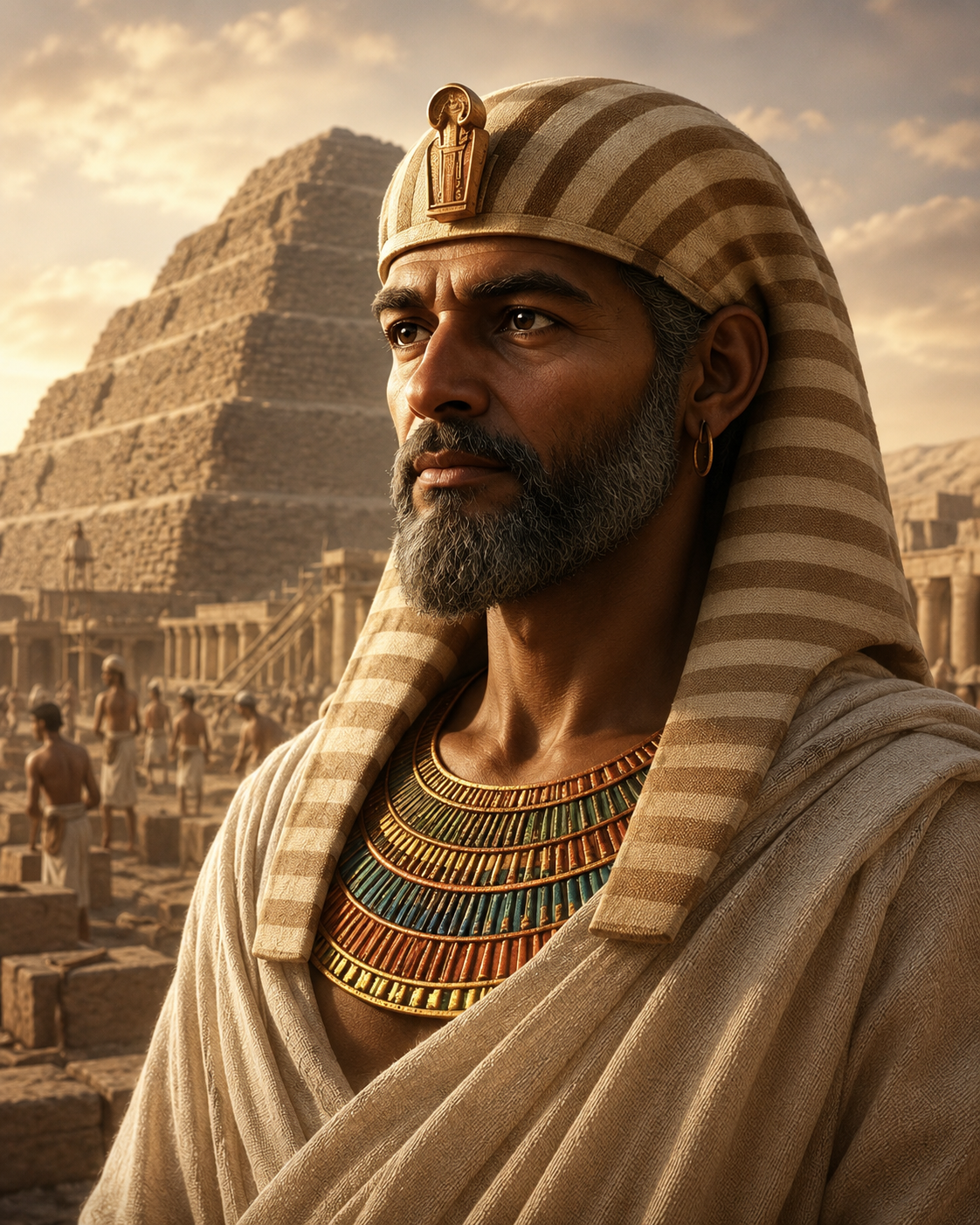
Every great pyramid, from Djoser to Khufu, was conceived as a mirror of cosmogony. Its square base, the earth, rises toward a pointed summit, the sky. The pyramidion at the top is the key: a relatively small stone that nevertheless condenses the entire myth of the benben. The famous architect Imhotep, designer of Djoser’s pyramid, may have been the first to formalize this symbolism in stone. His step pyramid clearly draws upon the model of the sacred mound. Later, smooth-sided pyramids such as those at Giza incorporated precise celestial orientations, their axes aligned with the constellations and the cardinal directions. The summit became a gateway to the stars.
The consecration rituals of pyramidia were elaborate: sacred oils were poured over them, incense was burned, and hymns were recited. Morning light falling upon the summit symbolically activated the “sacred machine.” Some pyramidia, such as the one from the pyramid of Khendjer of the Thirteenth Dynasty, have been found intact, decorated with hieroglyphs glorifying Ra and the deceased king. The connection is explicit: the benben is a stairway of light leading toward divinity. Even in smaller satellite pyramids built for queens or high officials, the same logic is present: every being deserves a point of contact with primordial light. In some cases, the summit stone may even have served as a solar calendar, casting coded shadows visible only during major religious festivals.
Influence on the Royal Funerary Architecture of the Old Kingdom
The idea of the benben runs through all sacred architecture. It appears in mastabas, solar temples, and above all in the pyramids of the Old Kingdom. Djoser’s pyramid, with its six tiers, is an architectural interpretation of the original mound. Each level symbolizes a stage in the cosmic ascent from earth to sky. Under Sneferu, father of Khufu, pyramids assumed a new form: smooth-sided and closer to celestial geometry. It was a reinvention of the benben, the myth brought into perfect form. The pyramid complex became an entire city: valley temple, ritual causeway, mortuary temple, and pyramid. Everything was organized around the idea of elevation. The king identified himself with the sun and rose each day toward the light.
In the Pyramid Texts, the dead king is called to “climb upon the shining stone” and to “become light.” Here, the benben appears as a stellar throne. Even in the later pyramids of Nubia, much smaller in scale, the pyramidion remains, proof of the symbol’s extraordinary longevity. It endured across centuries, transformed but never abandoned. Long after pharaonic Egypt had come to an end, the benben continued to inspire the imagination, from Greek esotericism and Arabic alchemy to certain modern symbols.
Conclusion
The benben is far more than a simple block of stone. It is the fossilized memory of the moment when the world emerged from nothingness, a spiritual matrix that gave birth to some of the most majestic forms in human history. In the half-light of the temples of Heliopolis, the stone may once have gleamed with a metallic radiance, catching the first rays of dawn. Millennia later, the gilded summits of the pyramids of Giza repeated that spectacle every morning along the banks of the Nile.
The benben, the stone, the mound, the summit, always marks a threshold: the instant when chaos becomes order, the formless becomes form, and shadow becomes light. It is at once origin and apex, foundation and fulfillment. Every obelisk, every pyramidion, and every tomb turned toward the sun repeats the story of creation. The king becomes Atum, the soul becomes Bennu, and light becomes eternity. Such is the story of the benben: a fragment of eternity lost in the sands, yet still alive in the shape of pyramids, in the flight of the Bennu, and in the undying imagination of humankind.
Further Reading on Echoes of Antiquity
- Imhotep and Djoser: Architect of Egypt's Step Pyramid at Saqqara
- Hapi, When the Nile Rose: The Sacred Breath of Water in Ancient Egypt
- Osiris, Isis, Set, and Horus: The Egyptian Myth of Death and Resurrection
Sources and Further Reading
This article draws on the Egyptian Pyramid Texts, Coffin Texts, the Book of the Dead, archaeological evidence from Heliopolis and surviving pyramidia, together with modern Egyptological studies of Egyptian cosmogony, solar religion, and royal funerary architecture.