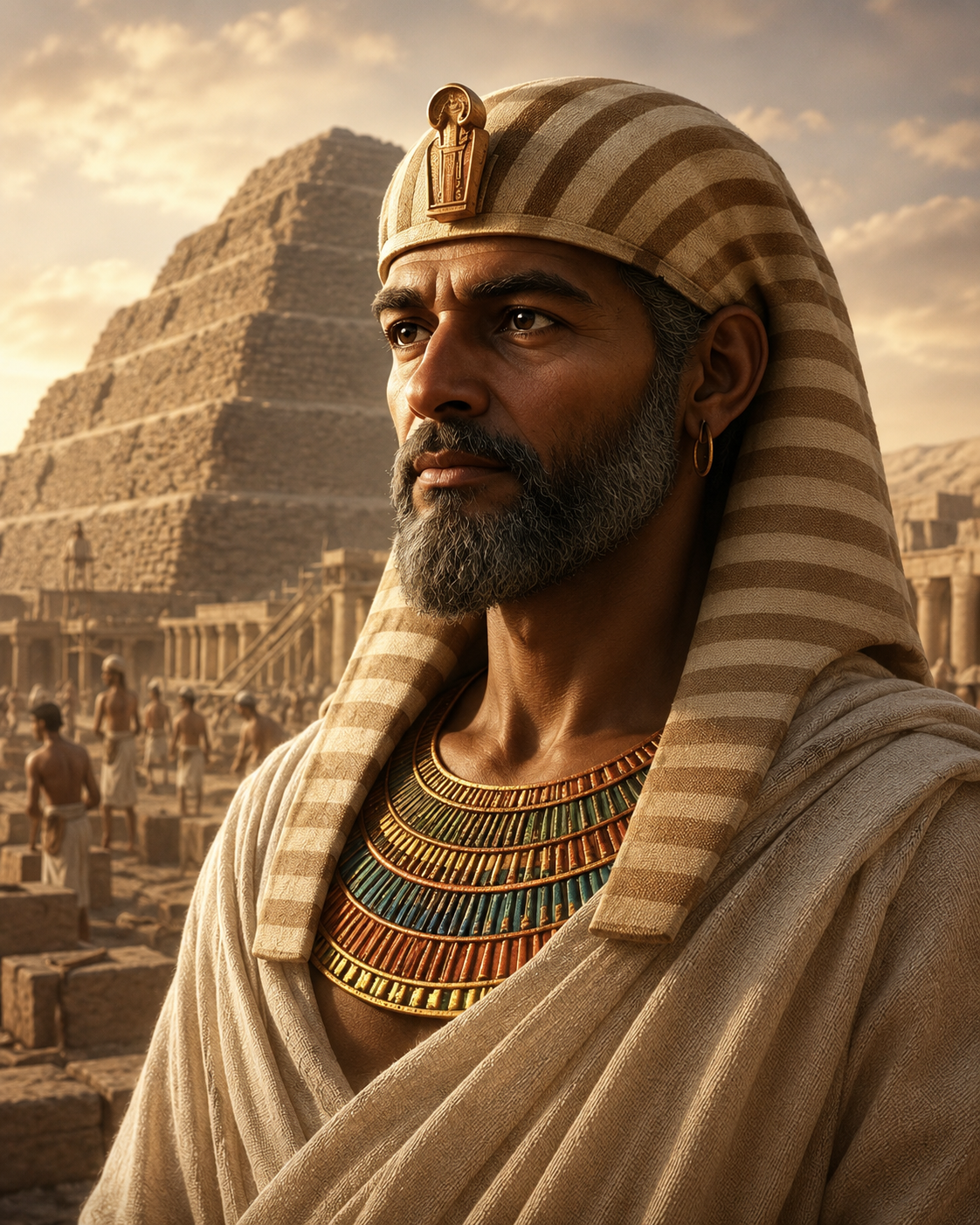
Who Was Imhotep in Ancient Egypt?
Imhotep, one of the most emblematic figures of ancient Egypt, was probably born near the end of the twenty-seventh century BCE, during the Third Dynasty, in the region around Memphis, then the capital of the Egyptian kingdom.
He may have been the son of a notable, or perhaps a man connected to the royal household. In either case, he grew up in an environment shaped by politics, administration, temples, craft workshops, and the immense ambitions of pharaonic power.
From an early age, Imhotep seems to have shown an unusual talent for learning and a remarkable intellectual curiosity. His education would have brought together mathematics, architecture, medicine, religious ritual, and the scribal arts, disciplines often transmitted by priests, scholars, and trained officials attached to the temples and the court.
His formative years were marked by the sight of grand monuments and by contact with artisans, builders, scribes, and administrators. This world gave him a deep understanding of construction techniques, medical practice, and the machinery of royal government.
As he rose in ability and reputation, his gifts were noticed. Imhotep entered the inner circles of Pharaoh Djoser's court and began the path that would make him one of the most influential and respected men of his age.
Imhotep at the Court of Pharaoh Djoser
As Imhotep matured, he was called to serve at the court of Pharaoh Djoser, where his skills in architecture and medicine were quickly recognized.
Djoser's court was animated by an unprecedented desire for grandeur and innovation. It gave Imhotep fertile ground for his vision. His first projects showed both technical mastery and a sophisticated understanding of building materials.
He distinguished himself by designing structures that were not merely useful, but also visually powerful. This ability earned him the trust and admiration of the pharaoh. Imhotep soon began to supervise increasingly ambitious projects and became a central figure in the architectural transformation of Egypt.
The Vision Behind the Step Pyramid of Saqqara
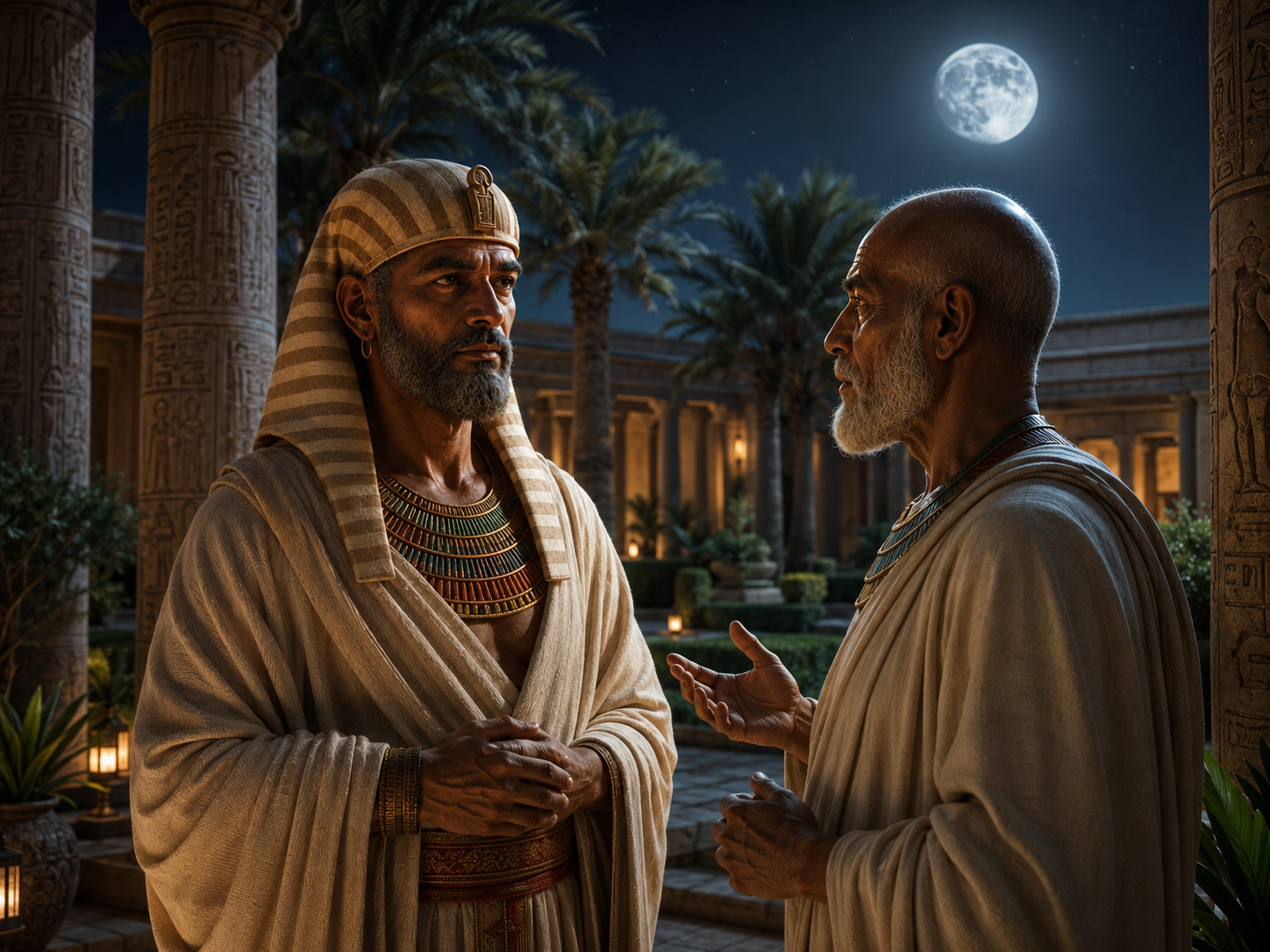
One night, as the full moon illuminated the gardens of the palace, Djoser, troubled by the thought of his own mortality, summoned Imhotep.
In the privacy of his apartments, the pharaoh, usually impassive, revealed his fear of death. He worried that his reign, his name, and his memory might be buried by the sands of time.
Djoser lamented the modest scale of his tomb. It was a mastaba, functional but insufficient before the greatness he wished to project. To him, it seemed too small, almost hidden within the funerary enclosure.
Understanding the depth of his sovereign's anxiety, Imhotep proposed an audacious answer: expand the mastaba upward, toward the sky. He imagined adding levels, enlarging the structure, and transforming the existing monument into something Egypt had never seen before.
This new tomb would be more than a burial place. It would be a monument to divine kingship, a beacon of royal memory, and a stone challenge to time itself. Imhotep explained that the pyramid would become a bridge to the afterlife, a passage toward Osiris, and a stairway to the eternal stars.
The promise of transcendence gave Djoser new determination. Convinced by Imhotep's vision, the pharaoh gave the project his full support. Thus began the Step Pyramid of Saqqara, a monument designed to resist oblivion.
Building Egypt's First Pyramid
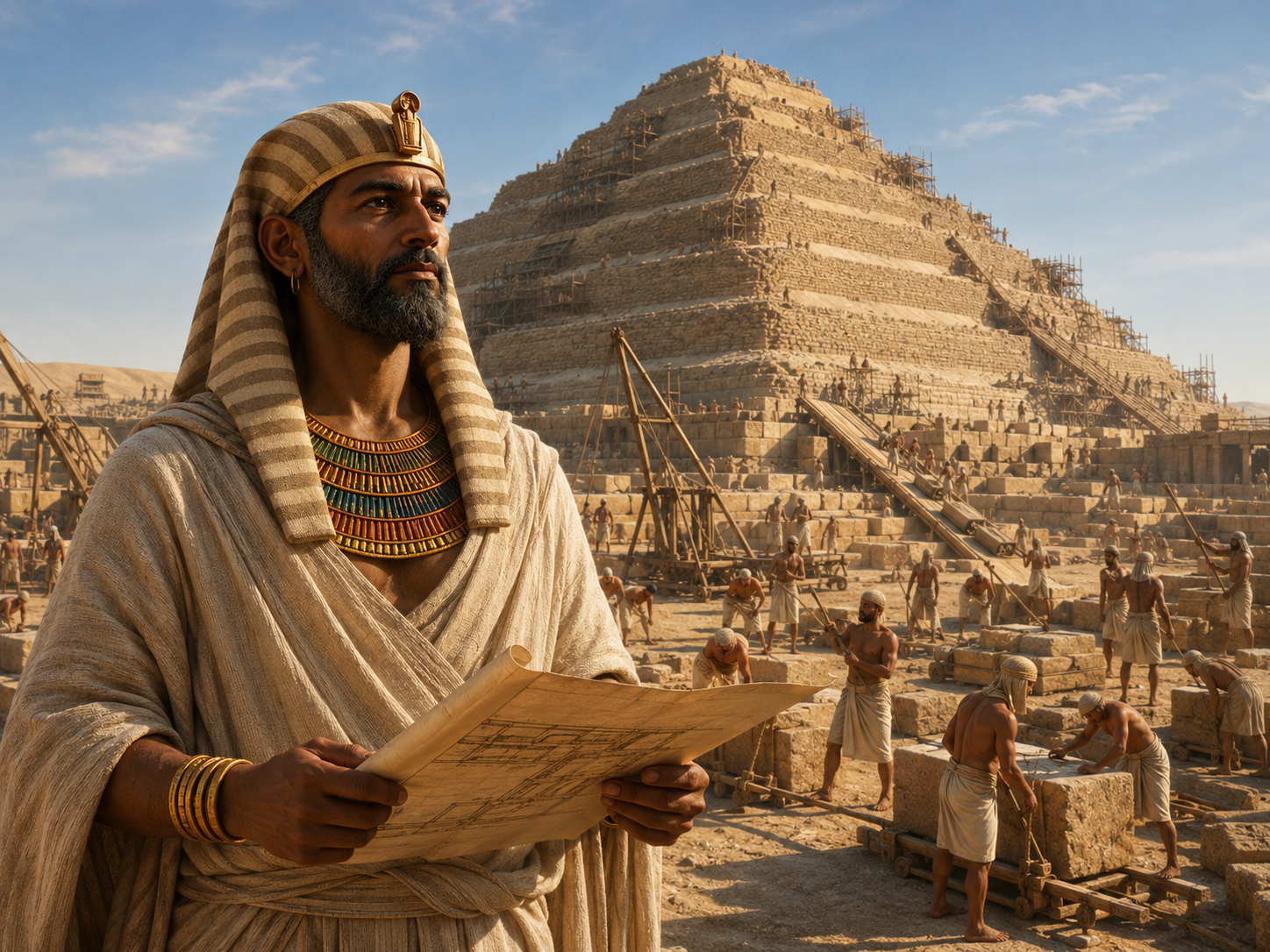
Under the blue, unchanging sky of Egypt, Imhotep undertook the design and construction of what would become the first step pyramid in history, a monument dedicated to the immortality of his king.
He chose the plateau of Saqqara. The project was revolutionary. It transformed the architectural landscape of Egypt and opened a new era of monumental royal construction.
The preparations were immense. Imhotep selected suitable limestone quarries and organized the transport of massive blocks to the building site. Each stone had to be cut with meticulous precision, reflecting both his technical skill and his pursuit of perfection.
Thousands of workers were mobilized and supervised by experienced craftsmen and engineers. The coordination of this vast labor force reveals Imhotep's extraordinary organizational intelligence: he could turn a vision into stone, labor, sequence, and result.
The construction itself was a technical achievement without precedent. Imhotep ultimately designed a structure of six superimposed mastabas, creating the distinctive silhouette of the Step Pyramid. Each level symbolized ascent, raising the pharaoh closer to the divine realm and the stars.
The foundations were firmly anchored, and the sloping walls helped ensure stability. Inside the pyramid, a complex network of chambers and corridors was designed to protect the royal body and the treasures that accompanied it.
Imhotep as Architect, Scribe, and Scholar
Imhotep's fame was not limited to architecture. His many talents carried him into several fields, and in each of them he acquired lasting prestige.
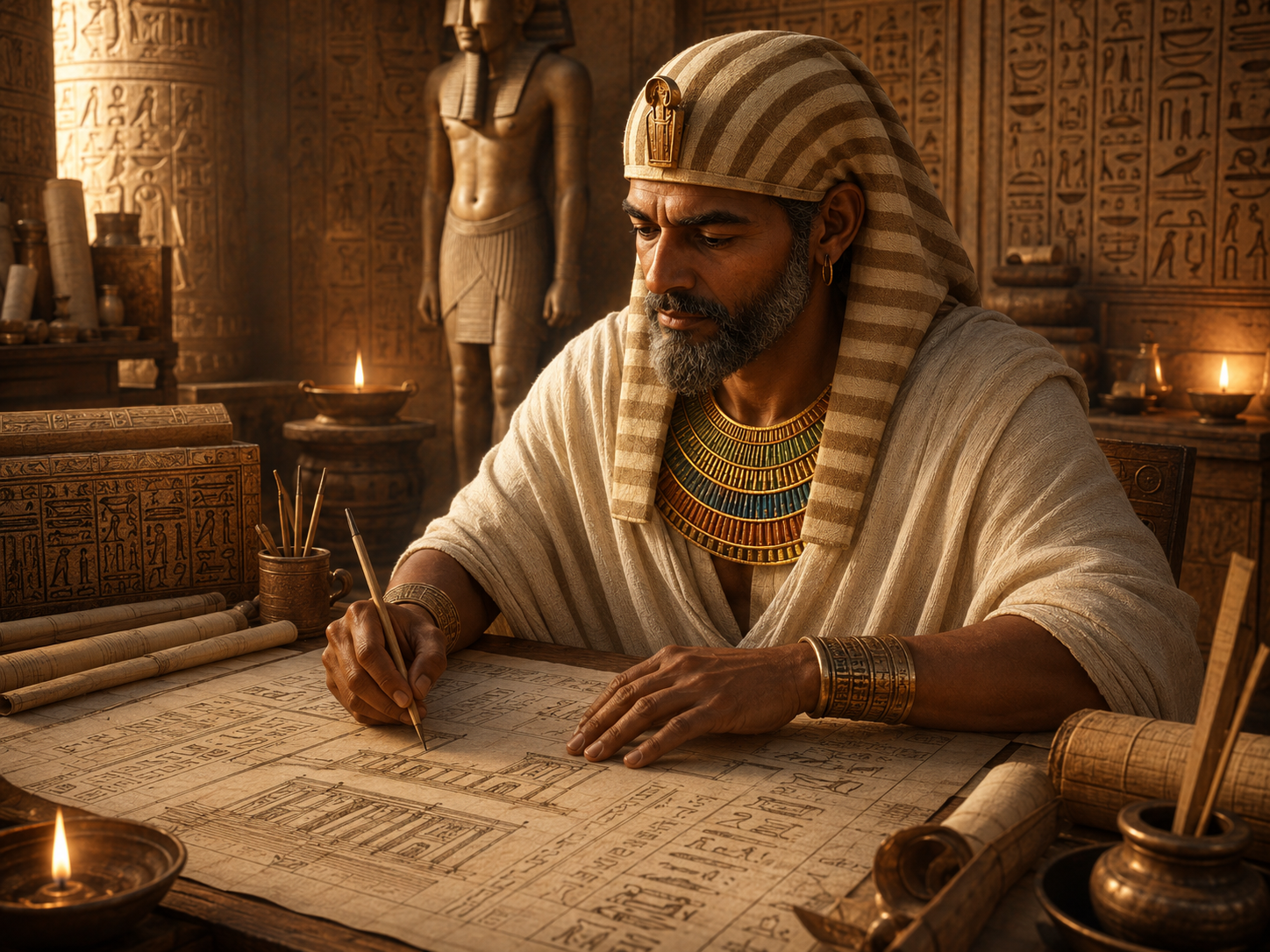
As a scribe, Imhotep devoted part of his life to writing and recording knowledge. Later tradition associated him with medical and scientific learning, presenting him as a master of observation, order, and practical wisdom.
Texts attributed to his intellectual legacy were treated with reverence by later scholars. Whether or not individual writings can be securely assigned to him, the memory of Imhotep became inseparable from the ideal of learned expertise in ancient Egypt.
He represented a rare combination: the technical mind of an architect, the disciplined hand of a scribe, the administrative capacity of a royal official, and the sacred authority of a priest.
Imhotep and Ancient Egyptian Medicine
Imhotep also served as high priest of Ra at Heliopolis, a position of immense prestige and influence. In this role, he participated in sacred rites and religious ceremonies, maintaining the relationship between gods, king, and people.
His spirituality and encyclopedic learning made him a respected mediator, able to advise the pharaoh and guide religious practice. The temples and libraries of Heliopolis became centers of knowledge, attracting students and scholars from across the kingdom.
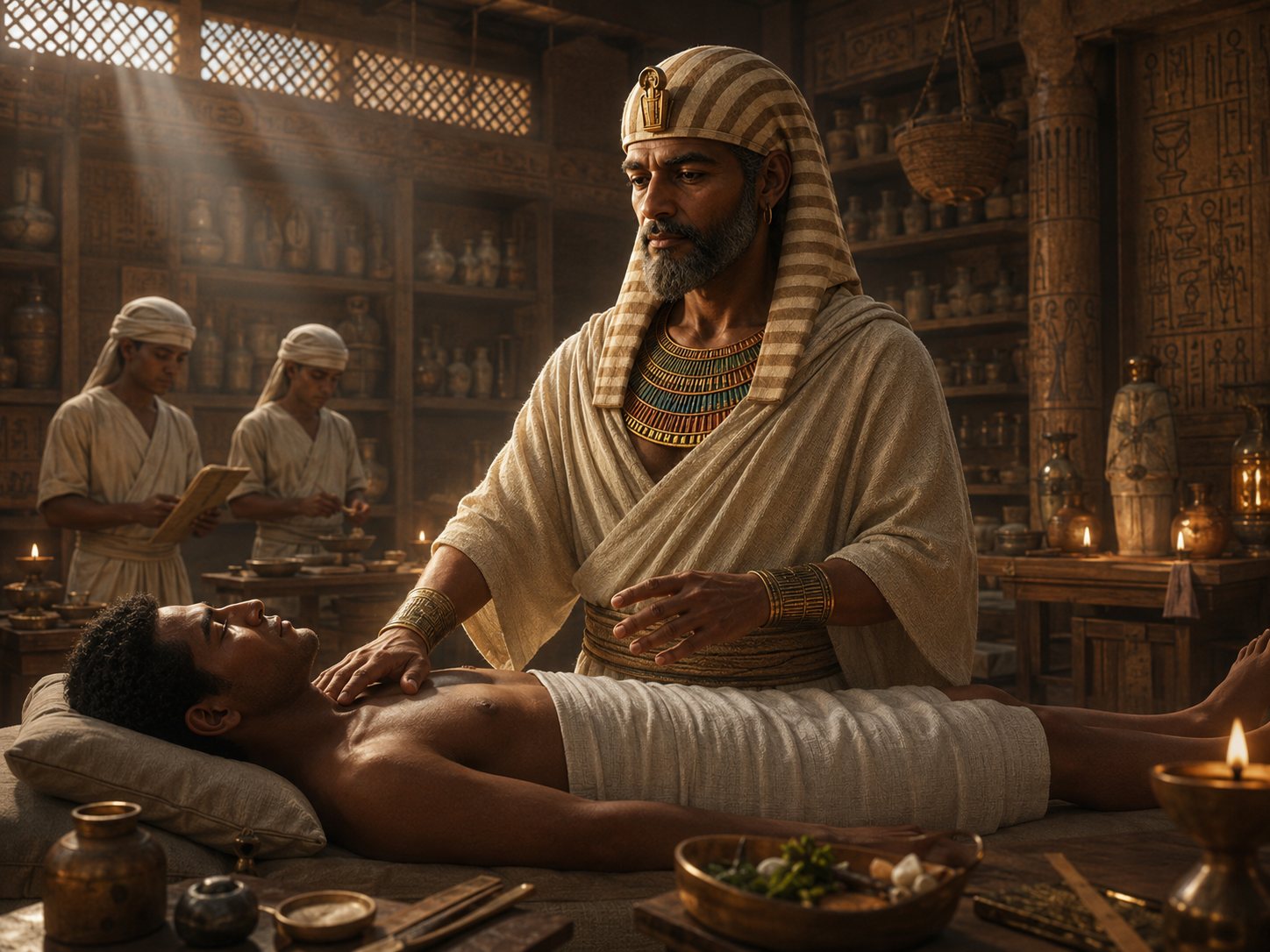
As a physician, Imhotep's later reputation became even more remarkable. Egyptian tradition remembered him as a healer whose methods rested on careful observation, experiment, pharmacology, and anatomy.
He was imagined developing remedies from local plants, preparing potions and ointments, and treating the sick with a method that joined medicine, spirituality, and empirical knowledge. This blend of healing and sacred power helped make him one of the most enduring medical figures of antiquity.
The Deification and Legacy of Imhotep
Imhotep's vast knowledge and central role in Egyptian society earned him a veneration that outlived him by centuries.
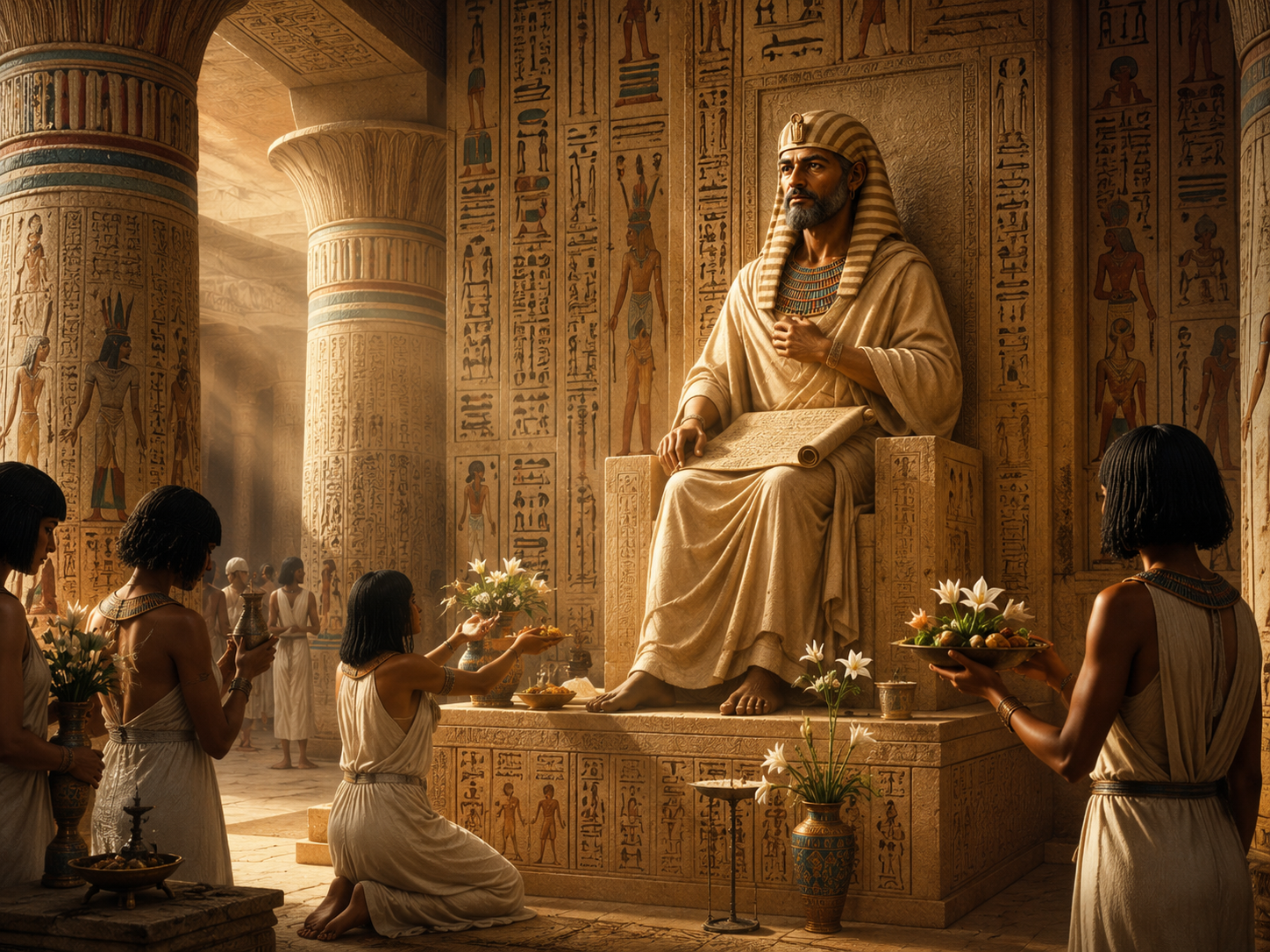
Long after his death, he was deified and worshiped as a god of medicine and wisdom. Temples were dedicated to him, places where the sick sought healing and scholars sought inspiration.
His renown was so strong that even in the Ptolemaic period, more than 2,500 years later, Imhotep remained an essential reference in the fields of medicine, architecture, and sacred knowledge.
Priests preserved his teachings and expanded his memory, ensuring that his legacy continued to shine through the ages. Today, Imhotep's name survives among the rare individuals of antiquity whose influence crossed the boundary between history and myth.
He stands as a symbol of the search for knowledge and progress, a figure at the meeting point of stone, science, ritual, and royal power.
What the sources say
Primary sources and modern references are listed in the source section below when they are available in the article. Historical caution remains necessary: the article follows the limits of the cited material and avoids adding claims beyond the evidence already presented.
Further reading on Echoes of Antiquity
- Hapi, When the Nile Rose: The Sacred Breath of Water in Ancient Egypt
- Osiris, Isis, Set, and Horus: The Egyptian Myth of Death and Resurrection
- Wenamun: Egypt's Humbling Odyssey to Byblos
Sources and Historical Landmarks
- Encyclopaedia Britannica, "Imhotep".
- Encyclopaedia Britannica, "Step Pyramid of Djoser".
- The Metropolitan Museum of Art, "Djoser's Step Pyramid Complex".


