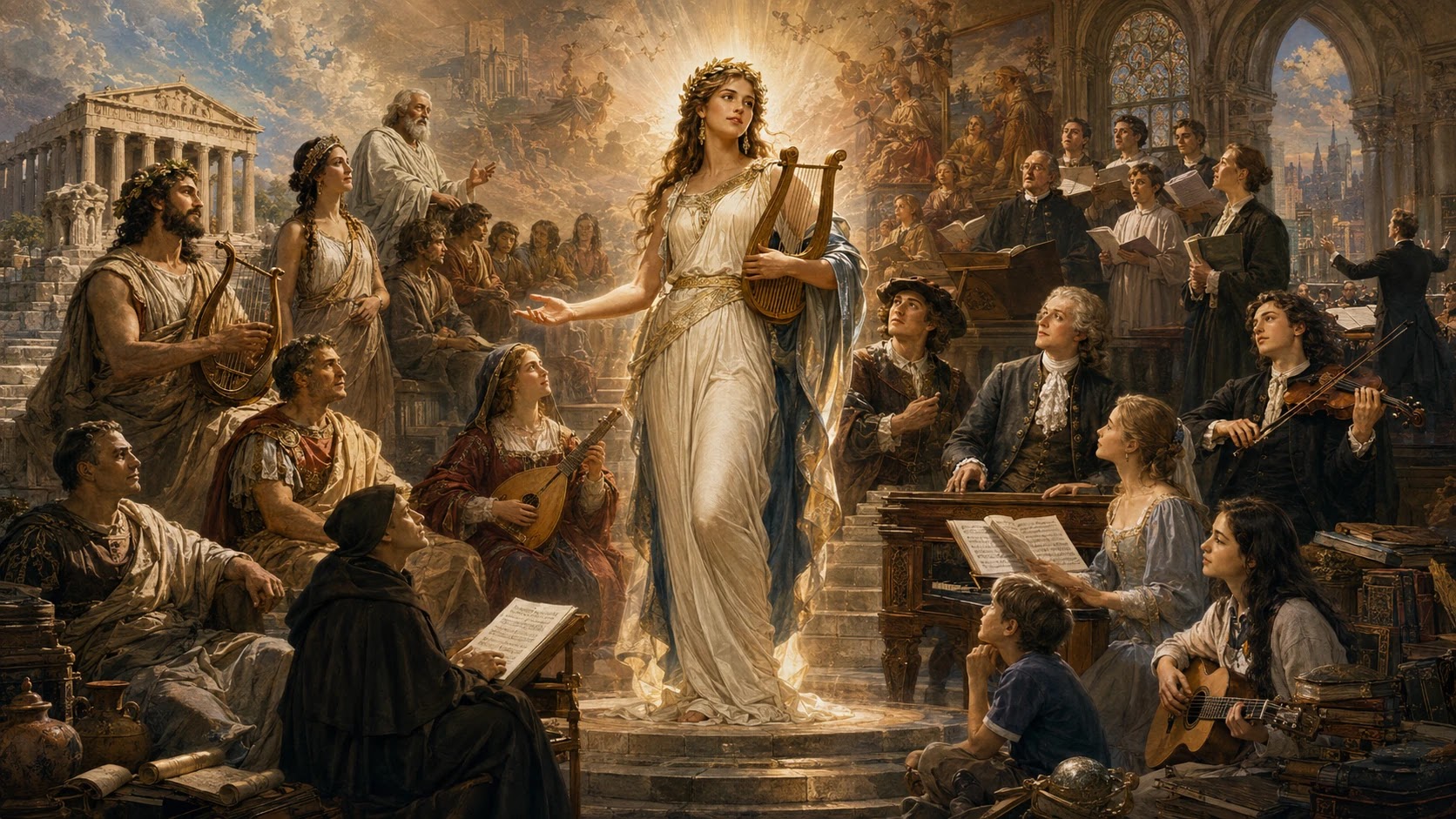
Discover Mousikê, the Greek foundation of Western music, where song, poetry, education, memory, and numbers still shape Europe today.
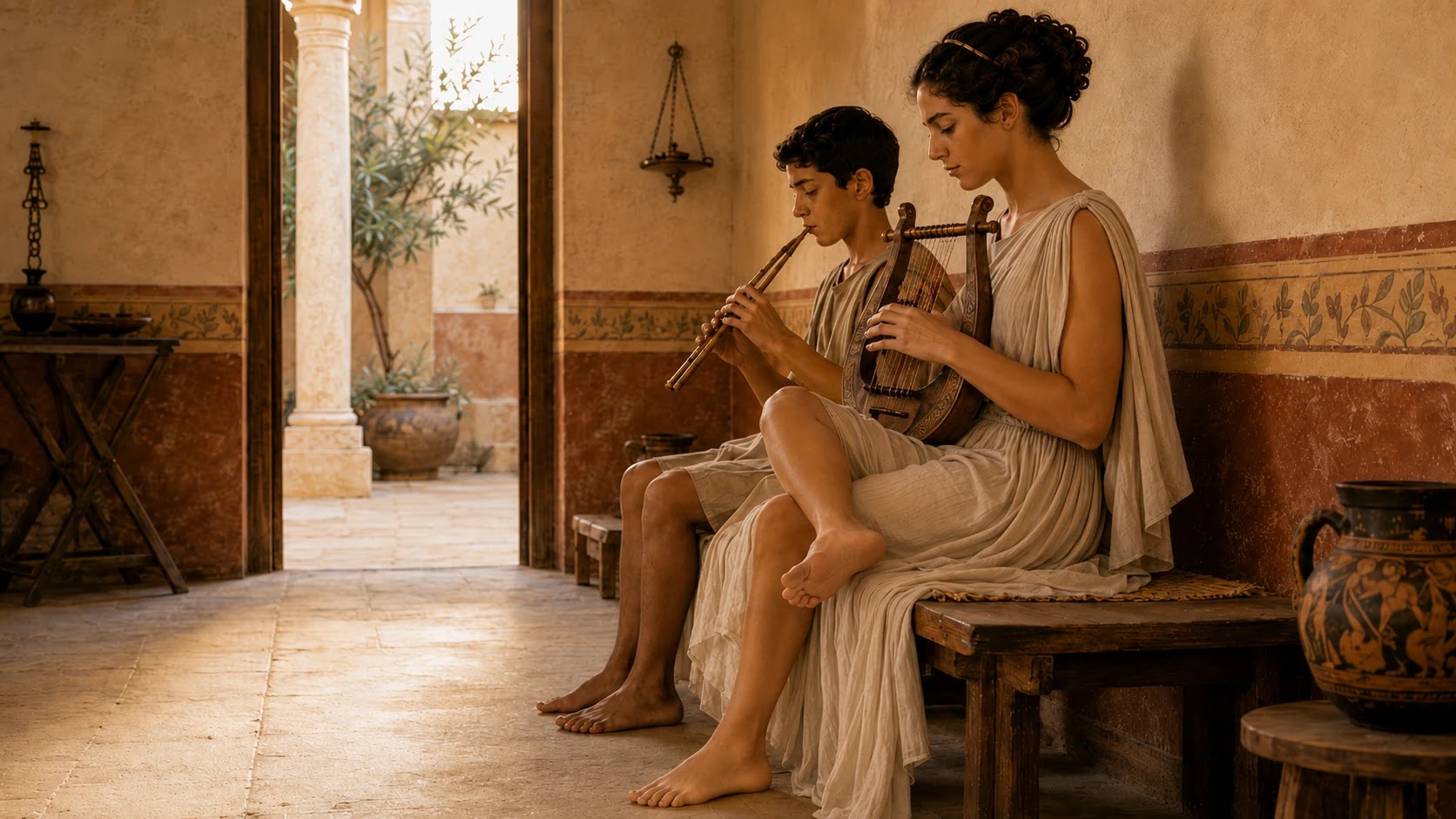
In the morning, in a Greek city still crossed by the coolness of night, a child sits beside his teacher. A lyre rests in his hands. It seems almost to breathe, as though it were waiting for someone to give it a voice. In this quiet, almost ordinary scene, an immense revolution is hidden: for the Greeks, learning music did not simply mean learning how to play. It meant entering culture, memory, the city, and the very order of the world.
Mousikê, When Europe Learned to Listen to the World
In the morning, in a Greek city still crossed by the coolness of night, a child sits beside his teacher. A lyre rests in his hands. It seems almost to breathe, as though it were waiting for someone to give it a voice. Its strings are not merely threads stretched across wood: they already whisper a promise. When the child plucks them, he is not only learning to produce a pleasant sound. He is learning to measure his gesture, discipline his soul, listen to the rhythm of a poem, hear the memory of his ancestors, and little by little become a citizen.
Around him, the city awakens. It too seems to speak. In the agora, voices answer one another like an improvised chorus. In a sanctuary, a hymn to Apollo rises, carried by voices searching for accord. Farther away, in the shadow of a house, a mother hums an ancient song, as though she were rocking time itself. For the Greeks, music was not mere entertainment. It refused to become background noise. It stood as a living presence: Mousikê.
The word comes from the Muses. They do not merely inspire songs: they watch over, guide, and transmit. They dwell in poetry, epic, history, dance, tragedy, eloquence, and the science of the stars. Their realm is immense, almost impossible to grasp. Where we now separate disciplines, they weave a single fabric. Mousikê thus becomes a force joining speech, body, sound, and thought.
I have often been struck, while teaching Antiquity, by this modern difficulty: we try to understand ancient civilizations through our own categories. We separate history, literature, music, philosophy, and religion, as though each field had always lived in its own locked room. But the Greeks did not think this way. They force us to undo our drawers, reopen the doors, and accept that culture is a vast palace whose rooms communicate with one another.
This is where one of the deepest foundations of European and Western music lies. Not because all our music directly descends from a few Greek songs miraculously preserved. That would be too simple, and even historically false. Western music was built through multiple inheritances: Greek, Roman, Jewish, Christian, Byzantine, medieval, popular, and learned. But ancient Greece gave music a soul, a way of thinking about itself. It linked music to education, morality, numbers, the cosmos, memory, and the city.
To understand Mousikê is to go back before staves, before Bach’s cathedrals of sound, before operas and symphonies. It is to recover a fragile moment when music was not locked inside one discipline, but moved freely, like a discreet light at the heart of the world.
Mousikê, an Art Far Larger Than Music
The Muses, Guardians of Human Memory
In Greek thought, nothing great begins without memory. It watches, insists, and refuses to disappear. Before singing the wrath of Achilles, Homer invokes the Muse. He does not speak alone: he calls upon a voice older than himself. The Muse thus becomes a presence, almost an invisible companion, guiding the poet.
The Muses are born from Zeus and Mnemosyne. Their very origin tells a story: they carry both power and remembrance within them. They do not decorate life. They sustain it. They prevent the world from sinking into oblivion.
An important nuance is needed here. The Muses belong to a mythological universe. They are not historical figures, but symbolic figures expressing how the Greeks understood inspiration, memory, and transmission. Their presence in ancient poems, hymns, and stories shows that Greek culture did not view creation as a purely individual act. The poet, singer, bard, and musician belonged to a chain larger than himself.
In a civilization dominated by orality, song becomes an act of resistance. It saves names, gestures, and griefs. It keeps the dead in the light. Mousikê then rises as a vigilant guardian, refusing to let silence erase what has been lived.
This may be one of the reasons the subject touches me so deeply. When you love history, you know that civilizations die less through the destruction of their stones than through the erasure of their voices. A broken column can still speak. A cracked vase can still bear witness. But when a song disappears, an entire way of feeling the world fades away.
A Discipline That United Poetry, Song, Dance, and Speech
Mousikê refuses to be trapped inside a narrow definition. It overflows. It includes sung speech, rhythm, bodily movement, poetry, the education of the soul, and even knowledge of the cosmos. It acts as a living bond between all these dimensions.
A Greek tragedy was not simply recited: it breathed, sang, and danced. It became a living organism in which each element answered the others. The spectator did not merely watch a story: he entered an experience in which the human voice tried to give form to the deepest emotions.
Likewise, epic poetry did not remain fixed in words. It moved forward, undulated, and carried heroes as the sea carries ships. The poem became a sounding body, vibrant and inseparable from its rhythm.
This union between poetry, song, and movement is essential for understanding ancient music. Today, we read Homer, Sophocles, or Euripides in the silence of books. The ancients, however, often received them in a world of voices, gestures, rhythms, and ceremonies. This gap explains why our modern perception of these works is sometimes impoverished: we preserve the words, but we have lost part of their breath.
Why the Greeks Did Not Separate the Arts
Modernity loves classification. It places the arts into compartments: music, literature, dance, theater, history, philosophy. The Greeks, however, often thought in terms of unity. The beautiful, the true, the just, and the useful could answer one another. A melody could shape character. A rhythm could discipline the body. A poem could teach courage or warn against pride.
Mousikê was therefore not a leisure activity reserved for moments of rest. It formed a common language between human beings, the city, and the gods. Song accompanied festivals, sacrifices, banquets, funerary ceremonies, competitions, sometimes war, theater, and education. It was everywhere, not as background noise, but as an invisible architecture.
This conception explains why Greek music marked Europe so profoundly. Even when ancient melodies were largely lost, the idea remained: music is more than pleasure. It touches the order of the world.
An Education Where Learning to Sing Meant Learning to Live
The Place of Music in Greek Education
In Athens, the education of a free young boy was not limited to learning how to read, write, and count. It also included gymnastics and Mousikê. Body and soul had to be formed together. Gymnastics gave vigor, endurance, and beauty of movement. Music gave measure, memory, a sense of rhythm, and self-mastery.
Yet this complete formation primarily concerned boys destined to become citizens. Women were generally excluded from this public education. Their learning took place within the domestic sphere, under family authority. Still, this does not mean they were strangers to Mousikê. Quite the opposite: they fully participated in musical life, but through other forms and in other spaces.
We should imagine these young pupils repeating verses, learning to accompany their singing on the lyre, discovering ancient poems not as dead texts, but as living speech. Beside them, in homes, women sang during family rites, weddings, births, and funerals. They transmitted ancient songs, lullabies, laments, and hymns connected to the cycles of life. Some, such as professional musicians or cultivated courtesans, could also master instruments and take part in banquets or artistic performances.
This idea deeply questions me. We often tend to present school as a place where separate forms of knowledge are accumulated. One hour of history, one hour of literature, one hour of science, one hour of art. Yet the Greeks, with all the limits of their society, remind us that education is not merely filling a memory. It is forming a way of being in the world. Mousikê did not only teach people to sing in tune. It taught them to listen in tune.
Musical education was not only meant to produce artists. It was meant to form men capable of taking part with dignity in the life of the city. But it also contributed, more discreetly, to shaping a collective memory carried by women’s voices, often invisible in the texts, but essential to transmission.
In this world, not knowing how to sing or play properly could appear as a cultural weakness. The musician was not merely the one who entertained. The cultivated citizen had to recognize forms, modes, rhythms, and poems. He had to hear what the city said about itself when it sang. And, in the shadow of institutions, women continued to keep this music alive in daily life, guardians of an oral tradition without which Mousikê itself could not have endured.
Forming the Citizen as Much as the Musician
Greek music had a deeply civic dimension. It taught people to be in tune, in the literal sense as well as the moral one. A chorus exists only if voices agree to breathe together. A rhythm requires common discipline. A religious festival demands that each person find his or her place within a shared order.
This is why Mousikê is one of the foundations of Western culture: it links the individual to the community. In music, a person is not only alone with his emotion. He learns to enter a collective form. To sing with others is to accept that one’s own voice does not always dominate. It is to inhabit a common measure.
This idea seems precious for our time. We live in societies where everyone has his own music, his headphones, playlists, preferences, and little kingdom of sound. It is a wonderful freedom. But Mousikê reminds us of another function of music: creating what is shared. Not erasing individual voices, but teaching them to answer one another.
This idea will then pass through European history. We will find it again in liturgical chant, church choirs, medieval and Renaissance polyphony, and collective practices of learned or popular music. Western music will inherit this tension between the individual voice and common order.
Plato and Aristotle Confront the Moral Power of Music
Greek philosophers took music very seriously. Plato mistrusted it as much as he admired it. In his thought, certain musical modes could elevate the soul, while others could soften or disturb it. For him, this was not a matter of personal taste. Music acts upon character. It shapes emotions even before reason intervenes.
Plato must nevertheless be read with caution. When he speaks of musical modes and their moral effects, he is not offering musical psychology in the modern sense. He is thinking as a philosopher of the ideal city, concerned with forming guardians, controlling narratives, and disciplining emotions. His reflection tells us as much about Greek political thought as it does about music itself.
Aristotle, more nuanced, also recognizes the educational power of music. It can serve relaxation, but also moral formation. It allows people to feel passions, understand them, and sometimes purify them. Through sounds, human beings learn what words alone cannot always explain.
This reflection on the effects of music would have a long posterity. From the Church Fathers to medieval theorists, from Renaissance humanists to modern thinkers, the West would return again and again to this question: does music make us better, more sensitive, more ordered, or can it lead us astray through excessive emotion?
The Secrets of Ancient Greek Music
Greek Modes and Their Influence on Emotions
Greek music rested on systems of modes, which ancient authors often associated with moral or emotional effects. The Dorian mode could be perceived as manly and balanced, the Phrygian as more exalted, the Lydian as softer. We must remain cautious: these categories do not correspond exactly to our modern modes, and their historical reality is complex.
We must therefore avoid a common misunderstanding. Saying that the Greeks associated a particular mode with a particular disposition of the soul does not mean that we can reproduce these effects exactly today by playing a modern scale with the same name. The systems have changed, the notations are fragmentary, and the practices have largely disappeared. But the essential idea remains powerful.
For the Greeks, a sonic organization was never neutral. The pitch of sounds, their succession, their tension and release could alter the inner state of the listener. Music was therefore not merely a decoration of the moment. It was a force.
This conception profoundly marked European musical thought. For centuries, people would continue to attribute affective colors to modes, keys, intervals, or rhythms. Even when theory changed, the intuition remained: every sonic form carries a mood, a light, a way of touching the soul.
The Instruments of Mousikê: Lyre, Kithara, Aulos, and Tambourines
Among Greek instruments, the lyre occupies an almost emblematic place. It accompanies education, song, and poetry. Its image evokes Apollo, measure, clarity, and balance. The kithara, more elaborate, belongs more to professional musicians and competitions. It shines in festivals, sanctuaries, and contests.
Opposite these stringed instruments stands the aulos, often translated as “flute,” even though it was rather a reed instrument. Its timbre must have been powerful, penetrating, sometimes almost spellbinding. The aulos accompanied processions, dances, certain cults, and moments of exaltation. If the lyre seems to converse with Apollo, the aulos readily draws us toward Dionysus, toward breath, trance, and the energy of the body.
The opposition between Apollo and Dionysus must also be handled with care. It is very useful for understanding two musical sensibilities, that of measure and that of intoxication, that of clarity and that of impulse. But it can sometimes simplify a more complex reality. The Greeks did not live inside sealed categories. Instruments, cults, and practices could intersect, answer one another, and transform according to places and periods.
There were also percussions, tambourines, krotala, and instruments associated with dances and rites. Ancient music was not an abstraction from a treatise. It vibrated in hands, lungs, and feet striking the ground. It had dust on its sandals and sunlight on its strings.
Rhythm, Poetry, and Sung Speech
In ancient Greece, rhythm was not understood merely as musical meter. It was linked to poetry. Long and short syllables, cadences, repetitions, formulas, all of these organized a sonic memory. The poem was a score before it ever became a page.
Epic, tragedy, and lyric poetry can only be fully understood if we remember that they were carried by the voice. The Greek text was not a butterfly pinned inside a book. It moved. It breathed. It advanced at the pace of the reciter, singer, or chorus.
This is one of the great legacies of Mousikê: in the West, music and poetry would remain linked for a very long time. Troubadours, trouvères, liturgical chants, motets, madrigals, operas, and lieder would extend in their own ways this ancient alliance between word and note.
Pythagoras, Numbers, and the Harmony of the Cosmos
The Discovery of Musical Ratios
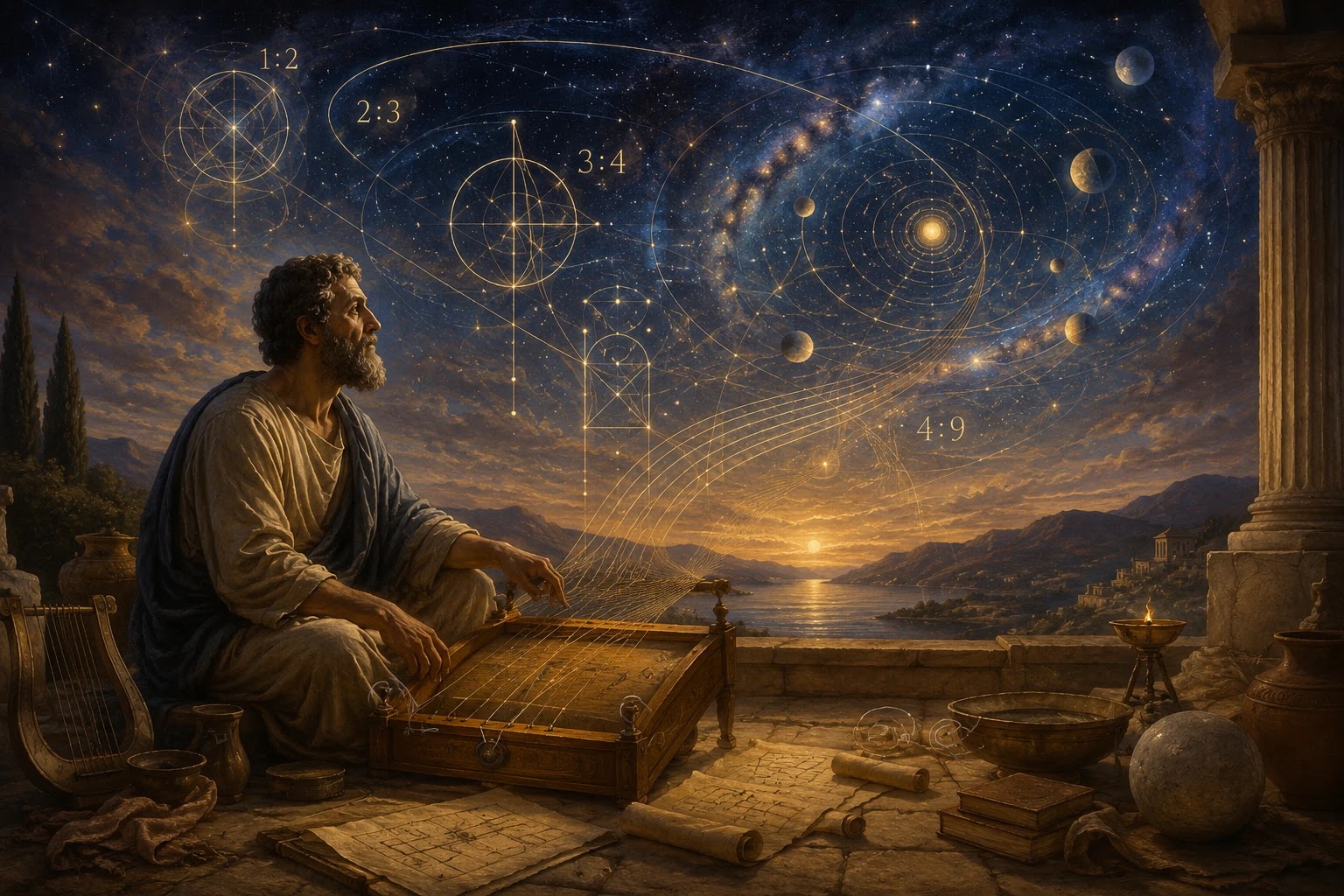
Tradition attributes a fundamental discovery to Pythagoras and the Pythagoreans: harmonious sounds obey simple numerical ratios. The octave can be expressed by the ratio 2:1, the fifth by 3:2, and the fourth by 4:3. Whatever the exact share of legend surrounding the master of Samos, the idea transformed the intellectual history of Europe.
We should be precise: the famous anecdote of Pythagoras discovering musical ratios after hearing blacksmiths’ hammers belongs to a late and largely legendary tradition. It is beautiful, but it should not be presented as a certain fact. What remains historically essential is the importance of the Pythagorean current in connecting music, proportions, and numbers.
Suddenly, music is no longer only a matter of the ear. It becomes a path toward numbers. Sonic pleasure reveals a structure. What is heard can be measured. What charms the soul possesses a mathematical architecture.
I particularly love this meeting between the sensory and the rational. It says something deeply Greek, but also deeply human: we can be moved by a vibrating string, then search behind that emotion for a law, a proportion, a hidden order. Music then becomes a door between two worlds that we too often oppose: the world of beauty and the world of thought.
This intuition is immense. It founds one of the great adventures of Western thought: searching behind sensory beauty for a hidden order. Music becomes a door between emotion and reason. It cancels neither. It unites them.
The Music of the Spheres
From this alliance between sounds and numbers emerges one of Antiquity’s most beautiful images: the harmony of the spheres. The stars, in their regular movement, would form a cosmic music. Not necessarily a melody audible to our ears, but a higher harmony, inscribed in the proportions of the world.
The idea is dizzying. The sky would not be a chaos of lights. It would be a composition. Planets, distances, and movements would participate in an order comparable to musical intervals. The cosmos would become an immense lyre, and by studying music, human beings would learn something about the world.
Here again, we must not confuse cosmic poetry with modern science. The music of the spheres is not a verified astronomical theory. It is a philosophical and symbolic representation, an ancient way of thinking about the order of the world by analogy with musical harmony. But this image had considerable power because it gave music an almost cosmological dignity.
This vision would deeply nourish the Middle Ages and the Renaissance. It gave music a learned dignity. It explains why, in the liberal arts, music was not merely a pleasant art, but a science of number in time.
When Mathematics Becomes Music
In the Middle Ages, music took its place in the quadrivium alongside arithmetic, geometry, and astronomy. This classification may surprise us today. We would instinctively place music among the arts, not among the mathematical sciences. Yet for the heirs of the ancient tradition, music studied proportions.
It reveals that the sensory world can be thought. A shorter string produces a higher sound. A consonant interval can be expressed by a ratio. Number becomes audible. It is an almost magical idea, but a rational kind of magic: reality sings in fractions.
This tradition does not lead directly to Mozart or Beethoven, of course. But it prepares an intellectual ground. It establishes the idea that music can be analyzed, written down, transmitted, and theorized. It becomes both an art of the senses and a science of order.
From Ancient Greece to the Birth of European Music
The Legacy Transmitted by Rome
Rome received much from Greek culture. It admired it, translated it, adapted it, and sometimes transformed it in its own image. In music, the Romans inherited instruments, performance practices, theoretical reflections, and learned traditions from the Greek world.
However, the Roman Empire did not preserve for us a music as directly readable as we might wish. The sounds have dissipated. What remains are texts, representations, instruments, fragmentary notations, and treatises. The ancient musical legacy reaches us like a fresco whose colors have partly faded.
Yet even in fragments, this legacy continued to circulate. Latin authors, encyclopedists, Christian thinkers, and medieval scholars transmitted part of ancient theory. Names changed, contexts were transformed, but music remained linked to education, morality, and numbers.
Christianity Takes Up Part of the Greek Tradition
Early Christianity did not arise in a cultural void. It developed in a world where Jewish, Greek, and Roman traditions crossed paths. Song very early held an essential place within it. Psalms, hymns, and sung prayers formed a new sonic landscape, but one nourished by several inheritances.
Christian thought would sometimes distrust the sensual power of music. It feared that the pleasure of sound might turn the soul away from spiritual meaning. Yet it also recognized that song could elevate, unite, and carry prayer farther than ordinary speech.
This tension proved fertile. It would give birth to a liturgical tradition of immense depth. Gregorian chant, even though it does not simply descend from Greek music, belongs to an intellectual world in which music was still thought of as order, measure, elevation, and sacred memory.
It is important not to present Gregorian chant as a simple direct heir of Greek music. It was born in a Latin Christian context, with its own traditions, liturgical uses, and medieval developments. But it belongs to a learned culture that preserved, transformed, and Christianized part of the ancient categories: order, measure, the moral power of song, and the spiritual value of harmony.
From Gregorian Chant to Western Art Music
With the Middle Ages, European music entered a new adventure. Notation developed. Chants became fixed. Voices gradually began to overlap. From liturgical monody would arise the first great forms of polyphony. Cathedrals would not only be architectures of stone. They would also become architectures of sound.
It would be false to say that medieval polyphony is Greek. It belongs to its own world: Christian, Latin, European. But behind it survives a very ancient inheritance: the idea that music is a discipline of order. One voice must find its place in relation to another. Intervals must be thought. Time must be measured. Beauty becomes construction.
Thus, from Greek Mousikê to medieval Western music, there is no straight line, but rather an underground river. Sometimes it disappears. Sometimes it resurfaces. It passes through Rome, monasteries, schools, treatises, and libraries. It carries fewer melodies than ways of thinking.
Why Mousikê Remains the True Foundation of Western Music
A Global Conception of Culture
The greatness of Mousikê lies in its breadth. It refuses to reduce music to an isolated pleasure. It makes music a way of inhabiting the world. Singing, dancing, reciting, counting, remembering, honoring the gods, forming the young, taking part in the city: all of this communicates.
This global vision may be what we lack most today. We listen to an enormous amount of music, more than any ancient civilization could ever have imagined. It accompanies us in transportation, work, solitude, and celebration. And yet we sometimes forget to think about it. It becomes rapid consumption, sonic decoration, emotion available on demand.
This is a thought I often have: never have we had so much music around us, and perhaps never have we treated it so much as mere accompaniment. It furnishes silence, covers waiting, and fills our journeys. But the Greeks remind us that music can be something other than background sound. It can become again a school of attention.
Mousikê reminds us that music is not merely something we put on in the background. It can be an education of the inner gaze. It can teach us to hear time, measure, memory, and the difficult accord between oneself and others.
Its Influence on the Liberal Arts of the Middle Ages
The passage from ancient music to medieval music also took place through the school. In the liberal arts, music retained a prestigious position. It was not only vocal or instrumental practice. It was the science of proportions. It conversed with arithmetic and astronomy.
This scholarly place had considerable consequences. It allowed music to be studied, commented upon, theorized. It removed music from the sole realm of gesture and inscribed it in the realm of thought. Medieval and then modern Europe would inherit this intellectual dignity.
Behind the Western composer, then, stands this very old idea: writing music is not merely producing pleasant sounds. It is organizing time. It is giving form to the invisible. It is holding together emotion, calculation, memory, and architecture.
What Our Modern Conception of Music Has Lost
Modernity has gained a great deal. It invented new forms, explored harmony, developed the orchestra, multiplied styles, and democratized listening. Humanity has never had access to such musical richness. In a few seconds, we can hear a Byzantine chant, a Bach cantata, a Romantic symphony, a blues song, an electronic track, or a lullaby from another continent.
But perhaps we have lost something of the ancient unity. For the Greeks, music was not cut off from education, poetry, the body, morality, and memory. It was not merely a matter of individual taste. It formed part of the human being.
Returning to Mousikê is not naively dreaming of a golden age. It is understanding that the foundations of European music are not only technical. They are spiritual, intellectual, and political. Western music was built on notes, of course, but also on a deep conviction: the world can be brought into accord.
And perhaps this is what still touches us. When we hear a voice rise in a church, a violin open a fragile phrase, or a choir breathe like a single body, we recover something very ancient. We are no longer merely facing a sound. We are facing a sensory order, a vibrating memory, a human way of resisting disorder.
The further I advance in the study of ancient worlds, the more wary I become of one comfortable idea: that we are more complex than those who came before us. The Greeks did not have our technologies, recording devices, or digital libraries. Yet they had understood that music could form a human being, bind a city together, order thought, and open a window toward the cosmos. That is no small thing.
Mousikê has therefore not disappeared. It has changed clothes. It no longer stands only beside Apollo, lyre in hand, in the clear light of Greek sanctuaries. It passes through our schools, stages, operas, churches, films, songs, and headphones. It continues to whisper that music is never merely music. It is the mysterious art of tuning the soul to the world.
Perhaps this is why I love returning to the Greeks. Not to search for a perfect model, for their world was also marked by exclusions, violence, and limits, but to recover questions we have sometimes stopped asking. What is a culture that sings? What is an education that teaches listening? What is a civilization that still seeks harmony between beauty, number, memory, and the city? In these ancient questions, there is still music for our time.
Key Takeaways
- Greek Mousikê does not refer only to music, but to a vast cultural field connected to the Muses, poetry, song, dance, memory, and education.
- In ancient Greece, music contributed to the formation of the citizen: it taught measure, listening, memory, and accord with the community.
- Plato and Aristotle show that the Greeks gave music moral and political power, even though their analyses must be placed within their philosophical context.
- The Pythagorean tradition durably associated music and numbers, especially through the ratios of the octave, fifth, and fourth.
- Western music does not directly descend from Greek music, but it inherits its way of thinking about music as order, culture, proportion, and memory.
Sources and further reading
- Armand D’Angour, "Ancient Greece," in The Oxford Handbook of Western Music and Philosophy, Oxford Academic, 2020. Read the source
- Colette Hemingway and Seán Hemingway, "Music in Ancient Greece," The Metropolitan Museum of Art, Heilbrunn Timeline of Art History, 2001. Read the source
- Ure Museum of Greek Archaeology, University of Reading, "The Well-tempered Lyre: Music education in ancient Greece." Read the source
- Matthew Wright, review of Penelope Murray and Peter Wilson, Music and the Muses: The Culture of Mousikē in the Classical Athenian City, Bryn Mawr Classical Review, 2004. Read the source
- Edmund Stewart, "The Profession of Mousikē in Classical Greece," in Skilled Labour and Professionalism in Ancient Greece and Rome, Cambridge Core, 2020. Read the source


