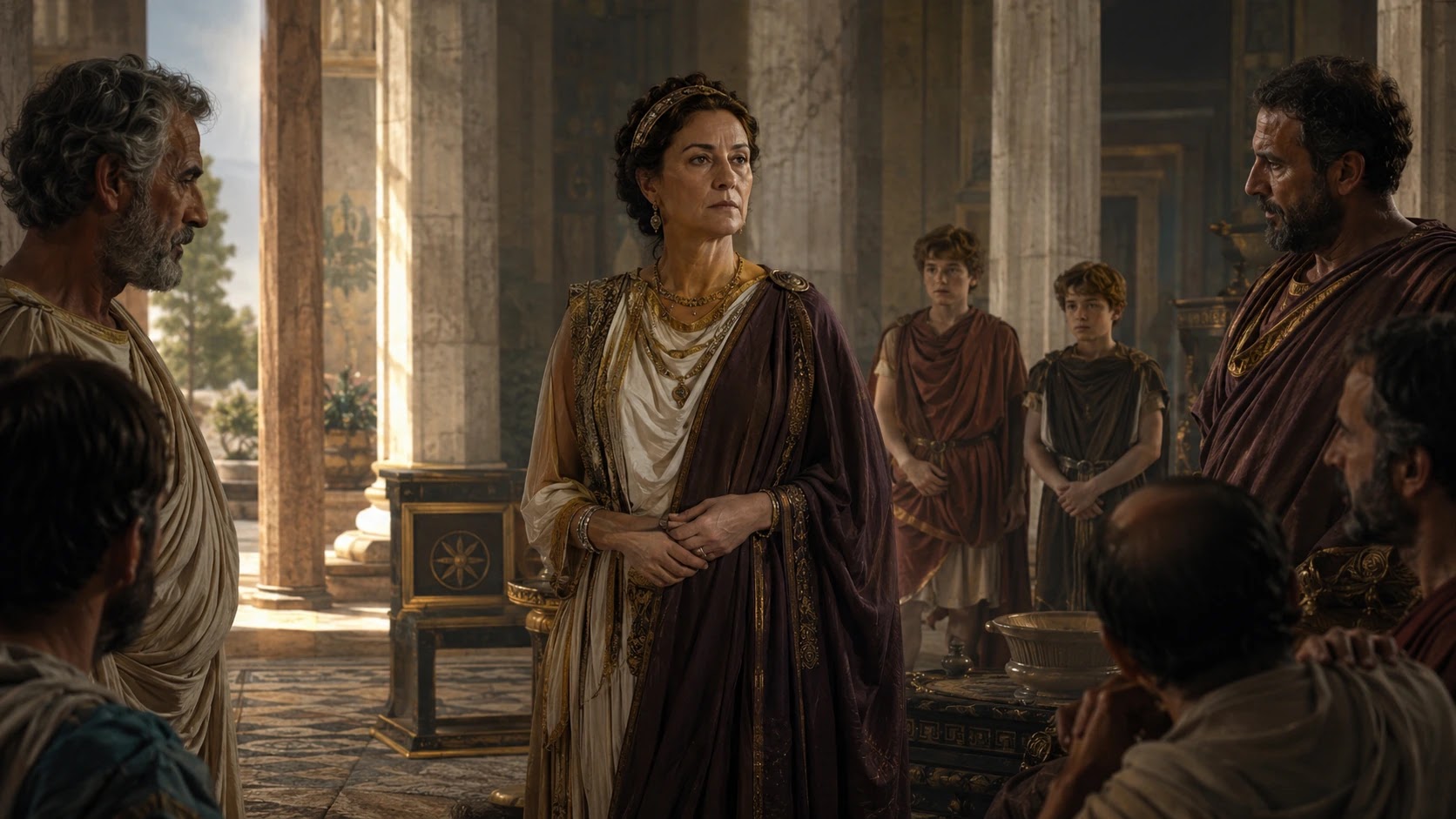
The Architect of Spartan Order
War, the 300, Leonidas, the Peloponnesian War: these are the images that come to mind when we think of Sparta. Under the unyielding skies of Laconia, Sparta seemed hewn from the very stone of its mountains: austere, resolute, indomitable.
But this city, admired for its legendary discipline and feared for its military might, was not always a model of rigor. At the origin of this transformation stands a mysterious figure: Lycurgus. Let us delve into the story of this architect of Spartan order.
Lycurgus, according to ancient accounts, lived in the 9th or 8th century BCE. But who was he? Was he a regent, a wise traveler, a reformer, or a symbolic construct created to explain a way of life? The texts oscillate between reality and legend. Herodotus portrays him as a legislator connected to Delphi and to foreign models, while Plutarch, in his Life of Lycurgus, attributes to him an almost divine wisdom.
What is certain is that the tradition places him in a Sparta torn by internal conflicts. Rivalries between clans, inequality of wealth, and political instability threatened the very existence of the city. Lycurgus, with a radical vision, undertook to transform this fragmented society into a unified community where the collective interest would prevail over individual ambitions.
The Oracle and the Return to Sparta
Before beginning his reforms, Lycurgus is said to have consulted the oracle of Delphi. The god's response was interpreted as a blessing: Sparta would prosper as long as his laws remained intact. Reassured by divine approval, he took charge of reorganizing the city.
But first, let us imagine the man. He was a being with a piercing gaze, marked by cold determination. His features, the accounts say, reflected the rigor of his mind: a square jaw, an austere face, short-cropped hair in the Spartan tradition.
Lycurgus was said to belong to one of the royal lines of Sparta, the Eurypontids, and to have served as regent after the death of his brother, King Polydectes. His royal status did not prevent him from leading a life of exemplary austerity, in accordance with the principles he later imposed on his fellow citizens.
Yet the story of his life remains hazy, as if shrouded in legend. Plutarch reports that after his brother's death, Lycurgus voluntarily ceded the throne to his brother's young son. This act made him respected, but it also exposed him to accusations and plots. According to some accounts, even members of his own family attempted to eliminate him.
A Journey in Search of Laws
To escape tensions, Lycurgus left Sparta and embarked on a long journey that would transform his worldview. He is said to have traveled to Crete, where he studied local institutions, then to Ionia, where he encountered the poetry of Homer. According to Plutarch, he also visited Egypt, where he took an interest in the organization of social orders, and perhaps even Libya and India.
Each stage of this journey reinforced a conviction: Sparta must become a city where order and discipline would surpass all individual ambitions. His return to Sparta marked the beginning of his legendary work.
Dressed in a simple tunic, he walked the streets, sharing his vision of a city where law would be sovereign. It is said that he used eloquence to convince, but also authority to impose the first measures. The portrait of Lycurgus painted by ancient authors is that of a man both pragmatic and visionary, ready to sacrifice his popularity for the common good.
He was also endowed with great resilience: a man of steel in a city of stone.
The Great Rhetra
Lycurgus devised an innovative political system, the Great Rhetra, which served as both guide and sacred constitution for Sparta. The organization rested on a subtle balance of powers.
At the top, two kings from the Agiad and Eurypontid dynasties shared authority. This diarchy, unique in the Greek world, limited abuses by dividing royal power. They were supported by the Gerousia, a council of 28 elders, and by the Assembly of citizens, the Apella, where every full Spartan citizen could participate.
Finally, five ephors elected annually exercised a decisive counter-power, even overseeing the kings. This ingenious system allowed Sparta to maintain rare stability. Where other cities wavered between tyranny, oligarchy, and democracy, Sparta presented itself as a city held together by balance and obedience.
Equality, Austerity, and Iron Money
One of the foundations of Lycurgus's vision was equality among Spartan citizens, which tradition says he imposed through drastic measures. He redistributed the land, giving each citizen family an equal parcel. To prevent the accumulation of wealth, he abolished gold and silver money, replacing it with iron currency: heavy, cumbersome, and lacking commercial value outside Sparta.
This material austerity extended to all aspects of Spartan life. Citizens shared communal meals in the syssitia, where the food was simple and frugal. Lycurgus himself is said to have set the example. "Let my table be that of all," he might have said, sacrificing personal comfort for the common good.
Yet this equality had a dark foundation. It applied only to the full Spartan citizens, the Spartiates. Beneath them stood the perioikoi and, above all, the helots, serfs of Messenian origin who worked the land so that free citizens could dedicate themselves to war.
Regularly humiliated and repressed, the helots lived under constant threat. The krypteia, secret expeditions in which young Spartans hunted and terrorized them, revealed the violence hidden beneath the ideal of civic equality.
The Agoge
The educational system attributed to Lycurgus, the agoge, remains one of Sparta's most famous institutions. Designed to forge citizen-soldiers, it embodied the Spartan ideal of discipline and devotion.
From the age of seven, boys left their families to join this collective school. Their training was brutal. A single cloak had to brave winter. Insufficient meals taught survival. Punishments were severe, intended to make them implacable. Pain became a teacher, hunger a discipline, silence a virtue.
Plutarch recounts the famous story of a boy who stole a fox cub to feed himself. Rather than reveal the theft when discovered, he hid the animal under his cloak until it bit him to death. Whether true or not, the anecdote illustrates the Spartan ideal: endure suffering to protect the city's honor.
Girls, though spared from the full agoge, also received demanding physical education. They trained in running, wrestling, and discus throwing, because Lycurgus was said to believe that strong mothers gave birth to powerful warriors.
A City Made for War
Thanks to Lycurgus's reforms, Sparta became an unmatched military machine. Every citizen was a soldier. War was not merely an obligation; it was a way of life.
The key to Spartan power lay in the hoplite phalanx. This compact formation, where each soldier protected his neighbor with his shield, embodied the essence of Spartan solidarity. The individual disappeared into the line. Courage became collective geometry.
During the Persian Wars, Sparta distinguished itself through its courage. At Thermopylae, the 300 Spartans led by Leonidas held off Xerxes' Persian army, embodying what later generations saw as Lycurgus's legacy: better to die than to yield.
The Limits of the Spartan Model
Despite its successes, the Spartan model had deep limits. The domination of the helots and the demand for military perfection weighed heavily on the city. The population of full citizens gradually decreased, weakened by war, inheritance problems, and the narrowness of the civic body.
Sparta's austerity made it strong, but also rigid. Its distrust of luxury protected civic discipline, yet limited economic and cultural flexibility. Its worship of military excellence created one of the most formidable armies in Greece, but also a society that struggled to adapt when the balance of power changed.
Yet Lycurgus's influence endured through the ages. Philosophers and thinkers, from Plato to Rousseau, found inspiration in his reforms. The Spartan vision, where discipline and equality blended with extreme austerity, remains a fascinating and terrifying utopia.
An Immortal City of Stone
One day, Lycurgus left Sparta, entrusting his work to his fellow citizens, and disappeared forever. In some versions, he made the Spartans swear not to change his laws until he returned, then chose never to return, sealing the city into obedience.
He left behind a city shaped by discipline and etched into history, eternal like the mountains that surround it. Whether he was a real legislator or the name given to a long process of reform, Lycurgus became the face of Spartan identity.
Sparta would rise, terrify, inspire, and decline. But the laws attributed to Lycurgus gave it something rarer than victory: a myth of itself.
What the sources say
Primary sources and modern references are listed in the source section below when they are available in the article. Historical caution remains necessary: the article follows the limits of the cited material and avoids adding claims beyond the evidence already presented.
Further reading on Echoes of Antiquity
- Aspasia of Miletus: The Brilliant Foreign Woman Who Changed Classical Athens
- The Battle of Marathon: The Clash That Shaped Western Civilization
- The Death of Ulysses: Telegonos and the Last Prophecy of Ithaca
- Eurydice of Macedon: Alexander the Great's Grandmother and the Argead Dynasty
Sources and Historical Landmarks
- Plutarch, Life of Lycurgus.
- Herodotus, Histories, Book I.
- Xenophon, Constitution of the Lacedaemonians.